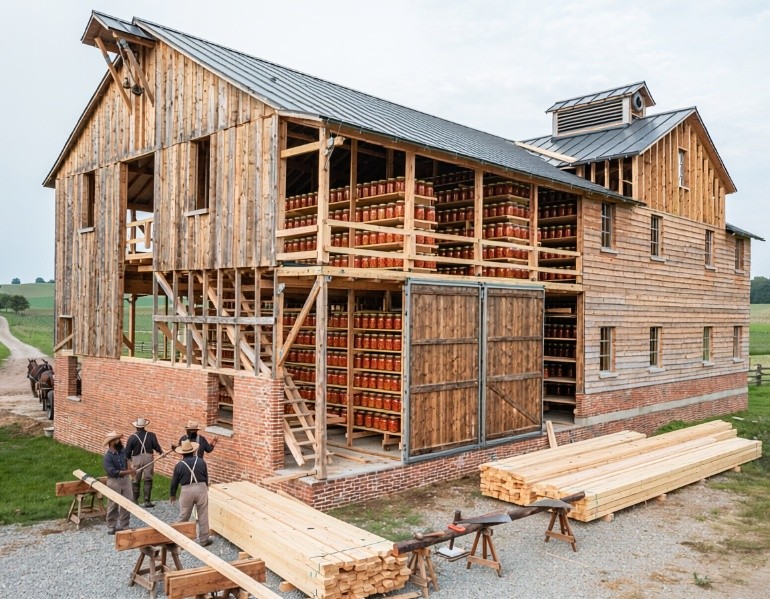
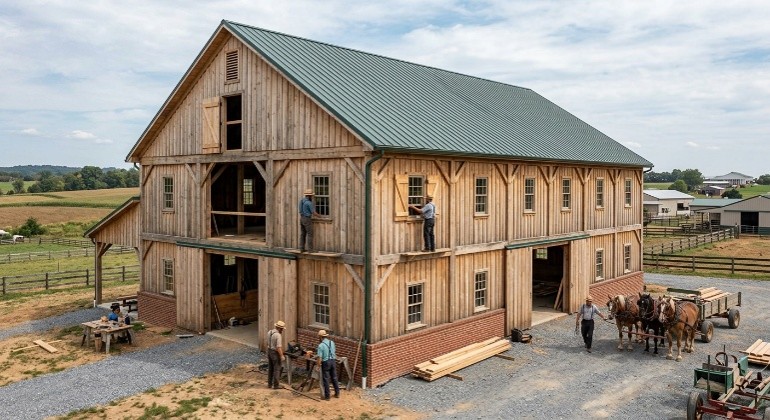
The pantry wore its roof before the week was out.
Frank Cooper had promised roof boards the morning after the ridge beam was raised, and by breakfast they were already climbing the frame in long bundles. Men worked from both ends, laying the boards tight against one another while others followed with strips of metal roofing brought from storage and trimmed at the blacksmith shop.
The steady ring of hammers traveled across the valley.
Below them, carpenters enclosed the walls with wide pine boards. Jake’s glassworkers fitted windows into the openings Wilson had left between the posts. Masons finished the chimney for the counting room, then moved downstairs to lay brick around the cool storage rooms built into the lower side of the slope.
The building changed almost by the hour.
In the morning it was a timber frame.
By noon it had walls.
Before supper, Saturn shone through glass windows onto the unfinished floors.
Samuel stood near the loading porch while Wilson inspected the doors at the eastern end.
“They are wide enough,” Samuel said.
Wilson opened one, then the other.
Together they revealed an entrance broad enough for two men carrying a large crate between them.
“Wide enough for today,” Wilson said.
Samuel looked toward the cannery, where another line of wagons waited beneath the drifting steam.
“That is becoming a dangerous phrase.”
Wilson smiled.
“I learned it from Frank.”
A wagon approached from the sawmill carrying boards thinner than anything being used on the pantry.
Samuel stepped aside as the team stopped near a temporary shed beside the building.
The load was made up of narrow strips of pine and box elder, most of them no thicker than a quarter inch. Bundles had been tied together by length. Short pieces lay in one stack, longer slats in another, and thicker corner pieces had been separated into wooden bins.
Frank walked beside the wagon.
Samuel picked up one of the thin boards.
“This will not make much of a shelf.”
“It is not for shelves.”
“What is it for?”
Frank lifted a finished wooden box from beneath the wagon seat.
The box was light enough for him to carry in one hand. Thin slats formed the sides and bottom, fastened to heavier corner pieces. Oval handholds had been cut into both ends. Inside, narrow strips of wood crossed one another to form twenty-four square compartments.
Samuel set the thin board down.
“A jar box.”
“A pantry box,” Frank said.
He placed it on the loading porch.
Samuel examined the joints.
The slats were nailed rather than pegged. Small nails could be made quickly, used sparingly, and driven without splitting the quarter-inch wood. The corners were reinforced, but nothing was heavier than necessary.
“How many jars?”
“Twenty-four.”
Frank pointed into the box.
“Four across. Six long.”
Samuel lifted it.
The empty box weighed almost nothing.
“It will not feel that way when it is full.”
“No,” Frank said. “A box of quart jars will need two hands and a sensible back.”
Samuel looked toward the cannery.
Finished jars were still being placed on temporary pallets beneath the loading shed. Workers moved them carefully, one jar at a time, before stacking them in rows.
“How many of these can you make?”
“That depends.”
“On what?”
“How much box wood you want.”
Samuel looked at the wagonload of slats.
“All of it.”
Frank nodded.
“That was the answer I expected.”
The sawmill had cut most of the heavy lumber for the pantry before Samuel asked for the building. Beams, rafters, flooring, and siding had already been stacked and drying beneath the sheds. Now, with the pantry frame standing and the greater part of its lumber delivered, the mill could change its work.
Frank had set aside the straightest pine and box elder logs.
They were too light for major beams and too soft for flooring, but they could be sawn into thin boards quickly. The wood dried faster than oak, cut easily beneath the sawmill blade, and weighed little once assembled.
By midday the order had reached the sawmill.
Box wood first.
Everything else second.
The mill carriage rolled another pine log toward the great blade. The saw screamed through it while men worked the levers and reset the log for the next cut. Fresh boards slid onto rollers at the far side, where boys carried them to the edging bench.
A second crew sorted the pieces.
Clear boards went to the box shed.
Knotted pieces were marked for kindling or short braces.
Thin slats were stacked beneath weights to keep them straight while they dried.
Frank walked through the yard checking each pile.
“Quarter inch,” he reminded one of the sawyers.
The man measured a board with his thumb and forefinger.
“Close enough.”
Frank handed him a measuring stick.
“Close enough makes crooked stacks.”
The sawyer adjusted the guide.
The next board came off thinner.
Frank nodded.
“Now every box fits every shelf.”
Beside the pantry, Wilson had turned the temporary shed into an assembly shop.
The work was divided into stations.
At the first bench, two apprentices trimmed the slats to length with hand saws using wooden stops clamped to the work surface. Each board was pushed against the stop before it was cut, so every piece came out alike.
At the second bench, another boy smoothed rough edges with a hand plane.
At the third, corner pieces were held inside a simple wooden jig while side slats were nailed into place.
At the fourth, bottoms were attached.
At the fifth, the removable dividers were fitted together and dropped inside.
The first boxes came slowly.
Every apprentice measured twice.
Some measured three times.
One boy put a side slat on backward, although no one could later explain how a plain board possessed a backward side.
Wilson pulled it free and handed it back.
“Again.”
By afternoon, the rhythm changed.
Cut.
Plane.
Fit.
Nail.
Turn.
Fit.
Nail.
The boxes began moving from one station to the next without waiting.
Samuel stood outside the shed listening to the light tapping of hammers.
Frank joined him.
“The pantry is not finished,” Samuel said.
“No.”
“The shelves are not finished.”
“No.”
“And you have started building boxes by the hundred.”
Frank watched another completed box join the stack.
“Jars are already waiting.”
Samuel nodded toward the cannery.
“They were waiting before we began the pantry.”
“That is why I am trying to catch them.”
Rebecca arrived carrying a jar of tomatoes.
She set it inside one of the finished boxes.
The jar slid neatly into its compartment.
She added another beside it.
Then she gripped the box and shook it gently.
The jars barely touched.
“That will keep them from knocking together on a wagon,” she said.
Frank nodded.
“The dividers lift out when the box needs washing.”
Rebecca examined the bottom.
“Leave enough space between the slats for water to drain.”
“We did.”
“And no rough points inside.”
Wilson ran one hand around the interior.
“The boys are planing every edge.”
Rebecca picked up the empty box and carried it toward the pantry.
Samuel followed.
She placed it on the first completed shelf near the loading doors.
The box fit beneath the shelf above with enough room for hands to reach the grips at either end.
She pushed it back until it met the stop board fixed against the wall.
“There should be two inches behind every box,” she said.
Wilson looked at the shelf.
“For air?”
“For fingers. Someone will eventually push one too far.”
He moved the stop board forward.
Rebecca nodded.
“That will do.”
Samuel watched her remove the jar and hand it to one of the cannery workers.
“You have been waiting to take possession of this building.”
“I had tomatoes in the laundry room.”
“So you mentioned.”
“I still do.”
The main floor was divided by a wide center aisle extending from one set of loading doors to the other. Heavy shelving lined both sides, broken by cross aisles leading toward windows and stairways. Near the kitchen entrance stood the flour room, separated from the rest of the pantry by tight wooden walls intended to keep dust from spreading.
Beside it was the counting room.
The stove had been installed.
The locked spice cabinet waited against the inner wall.
A bench stood outside the door exactly where Rebecca had asked for it.
She sat on the bench.
Samuel stopped.
“What are you doing?”
“Waiting for someone to count something.”
Wilson laughed from the next aisle.
Rebecca stood again.
“The bench works.”
The second floor was not built to carry the same weight as the first. Wilson had strengthened the beams beneath the planned jar sections, but Rebecca had already decided that heavy canned goods would remain below whenever possible.
Upstairs would go baskets, linens, empty jars, spare lids, dried herbs, seed sacks, crockery, and goods that could be lifted by the dumbwaiter without frightening the men operating it.
The loft was warmer and better ventilated.
Hooks had been fixed along the rafters for onions, garlic, and herbs. Open shelves waited for empty baskets and light equipment. The cupola above them allowed warm air to rise and escape through its louvers.
Samuel climbed the stairs with Rebecca.
At the loft landing she stopped beneath the roof.
The new boards still smelled strongly of pine.
Light entered through the cupola and fell across the floor in a bright square.
“This will be useful,” she said.
“You do not sound surprised.”
“I saw Wilson’s drawing.”
“A drawing is not a building.”
“No. A drawing has fewer stairs.”
They returned to the main floor, where the first shelving crew had reached the far wall.
Frank stood beside a stack of wide boards intended for the remaining shelves.
“We are running low,” he said.
“On lumber?” Samuel asked.
“On shelf lumber. Not on trees.”
Samuel glanced toward the box shed.
The stack of finished boxes had doubled.
“And the box wood?”
“Coming faster than they can use it.”
“Then keep it coming.”
Frank looked pleased.
“That is the second answer I expected.”
The first load entered the pantry before the western doors had been hung.
Rebecca did not wait for a ceremony.
Two boys pushed a handcart from the kitchen containing sacks of dried beans, three crocks of salt, two jars of mustard seed, and a basket of onions.
She directed the beans toward the inner shelves, the salt toward the dry room, and the mustard seed into the locked cabinet.
The onions went upstairs.
A second cart followed from the bakery carrying flour sacks that had been stored behind the ovens.
Then came vinegar from the creamery.
Beans from beneath the schoolhouse tables.
Empty crocks.
Spare lids.
Baskets.
Bundles of herbs.
A crate of soap.
Two women arrived from the laundry room with jars of tomatoes.
Samuel stood near the entrance as they passed.
Rebecca pointed toward a cleared shelf.
“Temporary tomatoes there.”
“Temporary?” Samuel asked.
“Until the boxes are ready.”
The first load of finished pantry boxes arrived from the shed less than an hour later.
The cannery workers had washed and dried the jars before placing them into the wooden compartments. Twenty-four jars filled each box. The red tomatoes showed through the glass in four straight rows.
Two men carried the first one between them.
Rebecca walked beside it.
“Not too close to the edge.”
The men placed it on the shelf.
It slid neatly beneath the one above.
A second box followed.
Then a third.
By the time the kitchen bell rang, an entire section of shelving glowed red.
Samuel stood in the aisle looking at the jars.
Frank stopped beside him.
“That shelf holds eight boxes.”
Samuel counted them.
“One hundred ninety-two jars.”
Frank looked at him.
“You counted.”
“I multiplied.”
“That is how counting rooms begin.”
The boxes solved more than the problem of moving jars.
They gave the pantry a measure.
A shelf no longer held an uncertain number of jars arranged wherever someone found space. It held eight boxes.
An aisle held twelve shelves.
A full section could be counted from the floor without touching a single jar.
Rebecca took a piece of chalk and wrote on the end of the first shelf.
TOMATOES
8 BOXES
192 QUARTS
She stepped back.
“There.”
Samuel studied the writing.
“What happens when someone takes one jar?”
“They do not take one jar.”
“What do they take?”
“A box goes to the kitchen. The kitchen returns the empty box.”
“And if it needs only one jar?”
Rebecca looked at him.
“When does the kitchen need only one jar of tomatoes?”
Samuel considered Rebecca’s kitchen, where hundreds of people ate in a day.
“That was a foolish question.”
“It was an optimistic question.”
On the following morning, the first empty boxes were returned from the kitchen.
They were inspected, wiped clean, and stacked beside the loading doors.
Nothing was discarded.
A loose slat could be replaced.
A bent divider could be remade.
A broken corner could be braced.
Even a box too damaged to carry jars could hold tools, rags, onions, or kindling before its final pieces reached the stove.
By the third day, the box shed had become the busiest small shop in the settlement.
Girls joined the boys at the assembly benches. Older workers showed them how to position a nail so it entered the corner post without splitting the thin slat. One apprentice learned to cut the handholds. Another became fast enough with the divider strips that he could assemble the twenty-four compartments without looking down at every joint.
Frank ordered more box wood.
The sawmill answered.
Wagons moved constantly between the mill, the box shed, the cannery, and the pantry.
Full boxes went in one direction.
Empty boxes returned in the other.
The system formed without anyone giving it a grand name.
It simply worked.
The pantry continued to change around it.
The outer siding was completed.
Both loading porches were roofed.
The last windows were set.
The dumbwaiter began carrying empty jars and baskets upstairs.
The counting room received a ledger, pencils, chalk, string, tags cut from thin wood, and a pot of coffee Rebecca insisted was for those doing the counting rather than those waiting on the bench.
Wilson finished the last shelf near the western doors and drove the final nail.
Rebecca immediately placed a basket upon it.
Wilson stared.
“You could have waited until I stepped away.”
“You were finished.”
“I had not admired it.”
“You may admire the basket.”
That afternoon the cannery sent its largest shipment yet.
The wagons arrived one after another, each loaded with boxes of tomatoes. Men formed a line from the loading porch to the shelves. Boxes passed from one pair of hands to the next.
No one carried individual jars.
No one searched for empty space.
Rebecca stood at the center aisle and directed traffic.
“Tomatoes left.”
“Beans to the second section.”
“Empty jars upstairs.”
“Vinegar near the kitchen doors.”
“Leave the lower shelf clear for crocks.”
The building swallowed the load.
The echo faded.
Each new box softened the room, replacing emptiness with the quiet weight of stored food.
Samuel entered near the end of the day.
He paused just inside the eastern doors.
The pantry no longer resembled the frame that had stood against the sky only days earlier.
The floors were swept.
The aisles were clear.
Light passed through the western windows and struck row after row of jars. Red tomatoes glowed through the glass. Green beans filled another section. Amber jars of peaches and preserves caught the light farther down the aisle.
Flour sacks stood on raised wooden platforms.
Barrels of vinegar rested in racks.
Crocks waited near the kitchen entrance.
Baskets hung from hooks.
Bundles of onions swung gently in the loft above.
Rebecca emerged from the counting room carrying the ledger.
Samuel looked down the long aisle.
“You filled it.”
“We began filling it.”
“That appears to be more than a beginning.”
She opened the ledger.
“We have not brought in the dried corn.”
“No.”
“The potatoes are still in the field.”
“Yes.”
“The apples have not been picked.”
“That is true.”
“The glassworks has three wagonloads of empty jars coming tomorrow.”
Samuel looked at the shelves again.
“Frank may have been right.”
“About what?”
“The warehouse.”
Rebecca closed the ledger.
“This is not a warehouse.”
“What is the difference?”
“A warehouse keeps goods.”
She looked toward the loading doors, where an empty box was being returned from the kitchen.
“A pantry feeds people.”
They walked outside together.
The porch ran the length of the building, wide enough for carts to pass beneath its roof. Beyond it, the cannery continued to breathe steam into the evening air. Wagons still waited in the yard. The sawmill blade could be heard in the distance, cutting another log into box wood.
Near the shed, apprentices stacked the last finished boxes of the day.
Every box was the same length.
Every shelf held the same number.
Every empty one would return to be filled again.
Samuel rested his hands on the porch rail.
“When we arrived here, people asked whether we had enough food for supper.”
Rebecca stood beside him.
“They still ask.”
“They do?”
“They ask me.”
“What do you tell them?”
“That supper is at six.”
Samuel smiled.
Behind them, workers carried another box through the pantry doors.
The building had been raised in record time because the lumber had been waiting, the trades had been organized, and no one needed to be persuaded that the work mattered.
Yet the speed of its construction was not what Samuel would remember.
He would remember the first shelf of tomatoes.
The light wooden boxes.
The women reclaiming jars from the laundry room.
The apprentices learning to make twenty-four spaces exactly alike.
The sound of full boxes settling onto shelves built only hours before.
The pantry had begun as an answer to a shortage of space.
It had become something larger.
A place where one harvest could wait for the next.
A place where work performed in summer could feed children in winter.
A place where abundance could be counted, protected, shared, and returned to the community one box at a time.
Rebecca looked through the open doors.
“It does not echo anymore.”
Samuel listened.
Inside, footsteps moved along the floor. A handcart rolled down the center aisle. Someone laughed near the counting room. A box settled onto a shelf with a firm wooden knock.
“No,” he said.
“It sounds like tomorrow.”