Morning came quietly to the valley.
Mist drifted above the artesian spring behind Rebecca's kitchen while the first rays of daylight settled over the rooftops of the growing settlement. The spring had faithfully supplied the kitchen since the first days of the community, but now Samuel looked at it with different eyes.
Thousands of gallons flowed away each day, untouched.
Beside him stood Rebecca, Jake from the glassworks, Elias Hawking, and Frank Cooper.
Samuel pointed toward the clear water.
"We've been drinking from it."
He smiled.
"Now it's time to share it."
Jake understood immediately.
"The glassworks can stop making jars for a few days."
Rebecca looked surprised.
"What would you make instead?"
"Bottles."
He grinned.
"Thousands of them."
Samuel nodded.
"That's exactly what I was hoping to hear."
By noon, the glassworks had changed its rhythm.
The molds that had been producing canning jars were replaced with bottle molds. Glowing gathers of molten glass became crystal-clear water bottles instead of wide-mouth jars.
Rows upon rows cooled slowly in the annealing ovens before apprentices carefully packed them into wooden racks.
Not one bottle was hurried.
Jake knew a hurried bottle became a broken bottle.
Good glass rewarded patience.
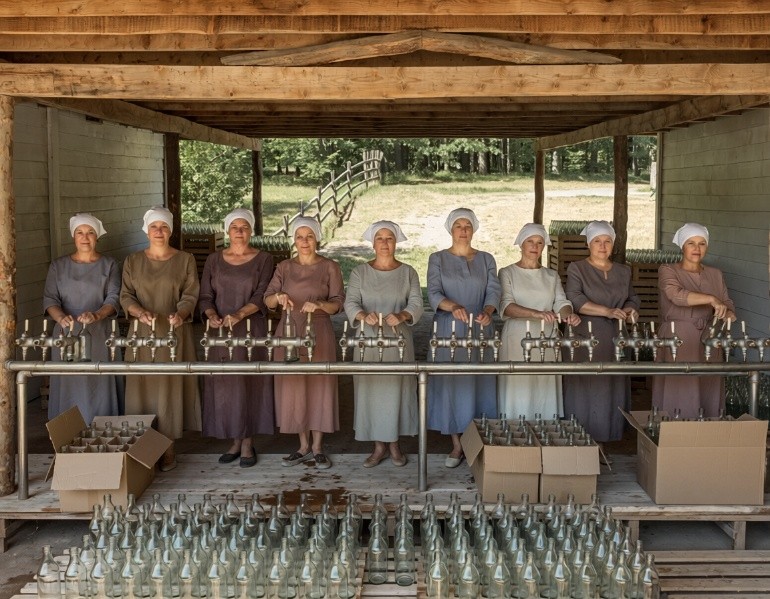
Meanwhile, Wilson and the carpenters built a long wooden awning beside Rebecca's kitchen.
The roof shaded the workers from the summer sun while allowing fresh air to circulate through the bottling station.
Long counters stretched beneath the roof.
Strong enough for hundreds of bottles.
Smooth enough to clean easily.
Nearby, Elias studied the flowing spring.
He scratched figures into a board before finally smiling.
"I don't think we'll need pumps."
Samuel looked over.
"What are you thinking?"
"The spring already has pressure."
He pointed toward the bubbling water.
"We'll simply guide it."
By evening, Elias and the plumbers had constructed a wooden manifold fed directly from the artesian spring.
Ten brass filling valves stood side by side beneath the awning.
Each delivered a steady stream of cool spring water.
Samuel opened one valve.
Water flowed smoothly into a waiting bottle.
He closed it again.
"Simple."
Elias smiled.
"The best ideas usually are."
The following morning Rebecca gathered the milkmaids.
Twenty women stood waiting.
Some still wore their aprons from the dairy.
Rebecca smiled.
"You've spent months learning cleanliness."
The women nodded.
"You already know how to handle food safely."
She pointed toward the new bottling station.
"Today..."
"...you're going to bottle the spring."
The women laughed softly.
One asked,
"Never thought I'd milk water."
Rebecca laughed with them.
"Today you do."
The bottling line found its rhythm almost immediately.
Each milkmaid worked at her own filling station.
A clean bottle was placed beneath the valve.
Fill.
Close the valve.
Insert the cork.
Fasten the cap.
Inspect the bottle.
Place it into the waiting crate.
Again.
Again.
Again.
The movement became as natural as milking cows.
No one rushed.
No one stood idle.
Behind the line, two young apprentices never stopped moving.
Their job was simple.
One carried clean bottles from the glassworks and kept every station supplied.
The other collected the empty bottle racks and returned them for another load.
Before a milkmaid reached for another bottle, one was already waiting.
The line never paused.
At the far end of the awning stood stacks of the new wooden bottle crates.
Frank Cooper had assigned his apprentices at the furniture shop to build them from quarter-inch pine.
Light enough for one man to carry.
Strong enough to protect forty-eight bottles.
Made to be used over and over again.
The crates fit neatly together.
When one was filled, two men stepped forward.
Without interrupting the flow, they lifted the crate onto a waiting handcart and wheeled it to the wagon.
The teamster stacked each crate carefully.
When the wagon was full, the horses leaned into their collars and quietly made their way toward the Community Pantry.
An empty wagon arrived almost before the loaded one disappeared down the lane.
The exchange became so smooth that no one gave it much thought.
It simply worked.
Rebecca stood beneath the awning watching the steady rhythm.
"It keeps moving."
Samuel nodded.
"It should."
She smiled.
"No one seems to be hurrying."
"They don't have to."
He watched one apprentice replace an empty rack of bottles before a milkmaid even reached for another.
"Everyone knows what comes next."
The artesian spring flowed as steadily as ever.
It neither hurried nor rested.
The people had simply learned to work in harmony with its rhythm.
Frank Cooper walked up carrying one of the new bottle crates.
He set it on the porch rail.
"The boys have these figured out now."
Samuel turned the crate over in his hands.
Quarter-inch pine.
Light enough to carry.
Strong enough to protect forty-eight bottles.
Built to be used again.
And again.
And again.
He handed it back.
"Nothing around here is made for one trip."
Frank smiled.
"Neither are the people."
Across the yard another wagon from the glassworks arrived with fresh bottles.
Before it had fully stopped, the apprentices were already unloading it.
At the same moment, the loaded wagon pulled away toward the pantry.
One replaced the other as naturally as breathing.
No whistles.
No shouting.
No confusion.
Just people who understood their work.
Samuel watched quietly.
Only weeks earlier these same people had arrived from every direction carrying little more than hope.
Now they moved together almost without speaking.
Each person's work made another person's work possible.
The glassmaker depended upon the spring.
The apprentices depended upon the glassmaker.
The milkmaids depended upon the apprentices.
The loaders depended upon the milkmaids.
The pantry depended upon the wagons.
Rebecca's kitchen depended upon them all.
Samuel looked across the settlement.
Smoke drifted lazily above Rebecca's kitchen.
The great pantry stood with its shelves steadily filling.
The cannery continued preserving another harvest.
The glassworks shimmered in the afternoon light.
Beyond them, the sawmill sang as another log disappeared beneath its great blade.
Everywhere he looked...
People were working.
Not because someone stood over them.
Not because they feared punishment.
But because each understood that honest work made the next person's work possible.
Samuel rested both hands on the porch rail.
"We've cultivated good fields."
He watched another wagon disappear toward the pantry.
"We've cultivated good orchards."
His eyes followed the long line of buildings stretching through the valley.
"We've cultivated friendships."
Rebecca stood beside him.
"And now?"
Samuel smiled.
"The Amish have never forgotten the first thing that must be cultivated."
Rebecca already knew the answer.
"Work."
Samuel nodded.
"Everything else grows from there."
For a long moment neither of them spoke.
The only sounds were the gentle splash of spring water filling bottles, the quiet clink of glass, the creak of wagon wheels, and the distant song of the sawmill.
The settlement had discovered something greater than efficiency.
It had discovered purpose.
Tomorrow the bottles would be filled again.
Tomorrow the wagons would return.
And tomorrow, just as today, every person would understand that civilization was not built by a single grand achievement.
It was built one day's honest work at a time.
The spring continued to flow.
The people continued to work.
And the valley quietly prepared itself for the generations yet to come.