Samuel left the cannery with the sound of tomatoes rolling through the receiving chute behind him.
They came from the wagons in a steady red river, tumbling over one another before disappearing into the machinery below. Men guided the baskets. Women sorted the fruit. Steam drifted through the open doors carrying the sharp, green smell of crushed vines and the deeper scent of tomatoes beginning to cook.
Beyond the cannery, another wagon turned into the yard.
Behind it came another.
Samuel stood aside while the first team passed. The horses walked slowly, their collars darkened with sweat, while the wagon boards creaked beneath a load piled nearly as high as the driver.
The harvest was no longer arriving by the basket.
It was arriving by the acre.
A second line of wagons carried the stripped tomato vines toward the hog pen. The sounder had apparently heard them coming long before anyone else.
The hogs crowded against the fence, squealing with such desperation that several cannery workers stopped what they were doing and turned to watch.
One large sow planted her front feet against the lower rail and raised her snout above the others. Her cries carried across the yard like a warning that starvation had arrived early and personally selected her as its first victim.
The first wagon tipped its load.
Vines, leaves, bruised tomatoes, and clumps of field dirt slid into the pen.
The hogs rushed forward.
For several moments the cannery yard stood nearly still.
Workers leaned against baskets. Teamsters twisted around on their wagon seats. Two boys carrying empty crates stopped in the road. Even Rebecca appeared in the kitchen doorway, wiping her hands on her apron as she watched the commotion below.
The hogs buried themselves in the pile, snorting and shoving, each one convinced that every spoiled tomato belonged to someone else.
Frank Cooper had once compared the community gatherings to watching a show.
Samuel thought the hog pen might be the preview.
The workers smiled, shook their heads, and returned to their jobs.
The cannery swallowed another wagonload.
Samuel watched the buildings around him.
Crates were stacked beneath the loading awning. Finished cans stood in cooling rows. Empty jars waited on wooden pallets from Jake’s glassworks. Flour arrived from Galileo’s mill in tightly sewn sacks. Butter, cheese, dried beans, salt, vinegar, and tools had begun finding temporary homes in every corner that could be spared.
Rebecca’s pantry was already full.
The kitchen storeroom was full.
A section of the barn had been partitioned with shelves, and it was filling faster than the carpenters could add boards.
Abundance had arrived before anyone had built a proper place to keep it.
Samuel turned toward the sawmill.
The road led past the kitchen, across the work yard, and toward the broad clearing where the sawmill stood beside a growing mountain of lumber. The great blade whined through another oak log as he approached. Sawdust rolled from beneath the carriage and gathered in pale drifts around the mill.
Frank Cooper stood beside a stack of fresh boards, marking their ends with a carpenter’s pencil.
He looked up when Samuel came near.
“I wondered how long it would take you.”
Samuel glanced at the lumber stacked around the clearing.
“How long it would take me to do what?”
“To discover Rebecca has run out of places to put things.”
Samuel smiled.
“She ran out yesterday. Today she began borrowing places from everyone else.”
Frank tucked the pencil behind his ear.
“That sounds like Rebecca.”
“How much lumber do we have?”
Frank turned and surveyed the yard.
Stacks of boards stood beneath open sheds. Heavy posts lay on cribbing to keep them off the ground. Rafters had been sorted by length, and several squared beams waited beside the mill carriage.
“Enough.”
Samuel waited.
Frank looked back at him.
“You want a number?”
“I want a pantry.”
“That is a much easier question.”
Frank led him between the lumber stacks. He rested one hand on a pile of wide oak planks.
“These are dry enough for flooring. The posts and main beams have already been squared. We have rafters cut, braces cut, and enough roof boards to close in a building before the next planting season.”
Samuel ran his palm along the edge of one board.
“You were expecting another project?”
“I am always expecting another project.”
“That is probably why we keep finding work for you.”
Frank nodded toward the settlement.
“Every time you people solve one problem, you build three more.”
Samuel looked back toward the cannery. Steam rose above its roof while wagons continued arriving from the fields.
“That is what growth looks like.”
Frank gave a quiet laugh.
“I thought growth looked like another stack of lumber disappearing.”
“Where would you put the building?”
Frank had already considered it.
He pointed toward a level piece of ground between Rebecca’s kitchen and the cannery. It stood close enough for handcarts to travel between the three buildings, but far enough from the cannery boilers that stored food would not be affected by heat or moisture.
“There,” he said. “A wagon road along the front. Loading doors on both ends. Raised floor, stone footings, and enough room underneath for air to move. We build it long instead of wide so the shelves are easy to reach.”
“How long?”
“One hundred and twenty feet.”
Samuel looked at him.
Frank raised both hands.
“You said pantry.”
“I did not say warehouse.”
“You will before winter.”
Samuel studied the proposed site.
The ground sloped gently away from the kitchen. Wagons could enter from the main road, unload beneath a covered porch, and continue around the building without turning in the yard. The cannery stood only a short walk away. The bakery and flour mill were close enough to use it without crossing the busiest wagon routes.
“How wide?”
“Sixty feet. Two floors and a loft.”
Samuel turned slowly.
Frank waited for the objection.
Instead Samuel asked, “How soon can you start?”
Frank looked past him.
Samuel followed his gaze.
Several carpenters were already walking toward them. Wilson came first, carrying a folded sheet of paper. Behind him were four apprentices with framing squares, chalk lines, mallets, and augers.
Samuel looked at Frank.
“You already started.”
“No,” Frank said. “I expected you to agree.”
Wilson unfolded the drawing across the top of a lumber stack.
The plan was simple.
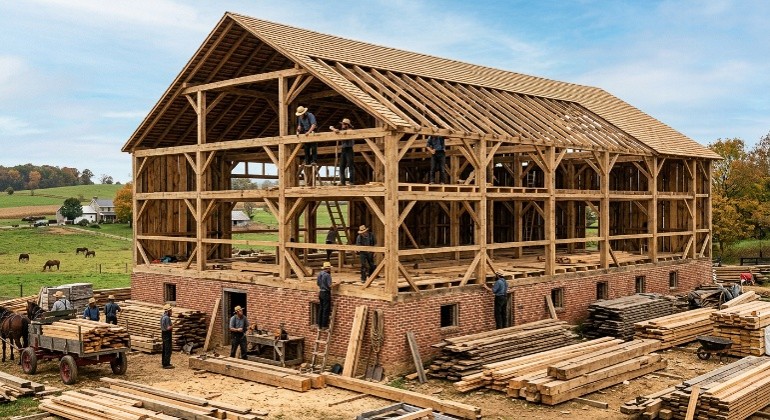
Heavy timber posts would stand on stone piers. Mortised beams would bind the frame together, strengthened by diagonal braces. Wide doors would open beneath a loading porch. The first floor would hold canned goods, flour, grain, dried beans, bottled water, vinegar, salt, and equipment used by the kitchen and cannery.
The second floor would store lighter goods: herbs, linens, baskets, seed sacks, empty jars, spare lids, crockery, and preserves.
A ventilated loft would provide space for dried onions, garlic, and anything else Rebecca decided should be hung from the rafters.
“There should be windows,” Samuel said.
Wilson nodded.
“Jake has glass waiting.”
“More than we need,” Frank added. “At least until Samuel finds another building.”
Samuel ignored him.
“Rebecca should see this.”
“She already has,” Wilson said.
Samuel looked at the plan again.
“What did she change?”
“The loading porch was her idea. So were the doors at both ends, the wide center aisle, the dumbwaiter, the flour room, the locked spice cabinet, and the wash table near the kitchen entrance.”
Frank folded his arms.
“She also said the shelves should not be built so high that every woman needs to fetch a carpenter before she can reach the peaches.”
Samuel nodded thoughtfully.
“She has considered it.”
Wilson pointed to a small room near the rear.
“That is for inventory.”
Samuel frowned.
“Inventory?”
“Rebecca called it a counting room.”
“That sounds more like her.”
By noon, the site had been marked.
Stone masons arrived from the brickworks with wagons of flat foundation stone. Carpenters stretched strings between wooden stakes. Apprentices checked corners by measuring from one end of the rectangle to the other, then measuring again from the opposite direction.
The first stones were set before the kitchen bell rang for the midday meal.
Rebecca came down the road carrying a basket covered with a clean cloth.
“You heard the bell,” she called.
Frank kept his eyes on the foundation line.
“We heard it.”
“You did not obey it.”
“We are working.”
“That is why I brought food.”
She placed the basket on a stack of boards and removed the cloth. Inside were thick slices of bread, cold ham, wedges of cheese, pickled cucumbers, and a crock of mustard.
Two girls followed carrying a coffee pot and tin cups.
The men gathered without needing further persuasion.
Rebecca stood beside Samuel and examined the rectangle taking shape across the ground.
“It looks large.”
“Frank says you will fill it.”
“Frank is learning.”
He handed her the drawing.
She studied it carefully, tracing the center aisle with one finger.
“The shelves should be spaced farther apart near the loading doors.”
Wilson leaned closer.
“Why?”
“Because people carrying crates will meet people pushing carts. If the aisle narrows there, everyone will stop and apologize while the food waits outside.”
Wilson took out his pencil and widened the opening.
Rebecca pointed again.
“And put a bench beside the counting room.”
“A bench?”
“Someone will always be waiting for someone else to count something.”
Wilson added the bench.
Frank watched him.
“At this rate, the building will be finished before the drawing.”
Rebecca folded the paper and handed it back.
“The building will be useful before the drawing.”
She poured Samuel a cup of coffee.
“Will it be ready soon?”
Samuel looked toward the stone masons.
The first row of footings already stretched along one side of the site.
“Soon enough.”
Rebecca glanced back toward the cannery.
Another wagon had joined the line.
“I have tomatoes in the laundry room.”
Samuel raised his eyebrows.
“Clean tomatoes?”
“They are in jars.”
“That does make a difference.”
“I also have sacks of beans under the schoolhouse tables, vinegar behind the bakery, and empty crocks in the creamery.”
Frank looked at Samuel.
“One hundred and twenty feet.”
Samuel nodded.
“One hundred and twenty feet.”
The foundation was completed in two days.
The timber frame began rising on the third.
The carpenters assembled each wall section flat on the ground. Heavy posts and horizontal beams were fitted together, their joints carefully cut and tested before oak pegs were driven partway into place.
Ropes were tied to the upper beams.
Men lined the opposite side of the frame with pike poles.
Wilson stood where everyone could see him.
“Take the slack.”
The ropes tightened.
“Walk.”
The first bent rose slowly from the ground.
Boots dug into the dirt. Shoulders leaned against the ropes. The massive timbers lifted together, groaning at the joints as the frame passed through the hardest part of its climb.
“Steady!”
The bent reached upright.
Men with pike poles guided the posts onto their waiting stone foundations. Temporary braces were nailed into place, and the ropes went slack.
Nobody cheered.
They simply moved to the next section.
By late afternoon, four bents stood in a row, connected by long beams. The skeleton of the pantry cast straight shadows across the construction yard beneath the glove’s soft evening light.
Children gathered at a safe distance to watch.
Several cannery workers came during their break. Flour dust still marked the clothing of two men from Galileo’s mill. Jake arrived from the glassworks and stood beside the wagon road, estimating windows before anyone asked him.
The last ridge beam remained on the ground.
It was the longest timber in the building, a straight oak beam cut from a tree that had stood in the valley longer than anyone could remember. Men had squared it at the sawmill, leaving enough of the grain visible to show what it had once been.
Frank walked its length, inspecting the ropes.
Carpenters waited high on the frame.
Samuel stood with Rebecca near the edge of the site.
The settlement had begun to gather without being called.
As the glove light softened over the valley, the last ridge beam was lifted into place.
Nearly two dozen men pulled together.
The beam rose from the ground, slow and heavy, turning slightly as the ropes tightened. Men standing on the frame reached for it with pike poles and guided it between the waiting rafters.
“Hold there,” Frank called.
The beam stopped in midair.
One rope was shifted.
“Again.”
It climbed the final few feet.
A carpenter straddling the upper frame reached down and placed both hands against the timber. Another man guided the opposite end toward its mortise.
“Easy.”
The first end settled.
Then the second.
For one breath, the whole structure seemed to hold itself still.
The carpenter raised his mallet.
The first oak peg went home.
Thunk.
Another mallet answered from the far end.
Thunk.
Soon the blows traveled along the ridge, each one drawing the timber tighter into the frame.
Thunk. Thunk. Thunk.
The sound carried across the cannery yard.
Workers paused beside the receiving chute. Teamsters turned on their wagon seats. Women stepped from the kitchen porch. Children stood quietly along the road.
Even the hogs seemed to have exhausted their complaints.
Samuel removed his hat.
Around him, others did the same.
Only the mallets continued.
Weeks earlier, the valley had held scattered buildings, uncertain plans, and people wondering what might happen next.
Now cabins lined the road. The bakery ovens stayed warm. The mill ground flour. The creamery churned butter. The glassworks made jars and windows. The cannery processed tomatoes faster than the fields could send them.
And rising between them stood a building meant not to rescue people from hunger, but to hold what their work had produced.
Frank stepped down from the frame and came to stand beside Samuel.
“There,” he said. “Your pantry.”
“It does not have a roof.”
“You asked how much lumber we had.”
Samuel looked up at the ridge beam.
“I believe you.”
Rebecca studied the frame from end to end.
“How long before I can use it?”
Frank considered the question.
“Roof boards tomorrow. Siding after that. Floors as soon as the masons finish the chimney base.”
“Chimney?”
“A small stove in the counting room.”
Rebecca nodded.
“Good.”
Frank glanced at Samuel.
“She knew about that too.”
“Of course she did.”
The final peg was driven.
The carpenter lowered his mallet and looked down from the ridge.
No speech followed.
None was needed.
The people began drifting back toward their work. The cannery chute started rattling again. Wagons moved forward. The kitchen doors swung open as Rebecca’s helpers returned to supper preparations.
Samuel remained where he stood.
The timber frame rose against the evening sky, large enough to hold thousands of jars, sacks, crocks, and cans.
Yet the building seemed to hold something else already.
Confidence.
Not the loud confidence of promises or speeches, but the quieter kind built from straight walls, full fields, sharpened tools, and people who returned each morning ready to continue.
Yesterday they had worried whether there would be enough.
Today they were building a place to put the excess.
Samuel placed his hat back on his head.
“Frank.”
Frank turned.
“You had better keep cutting lumber.”
Frank looked toward the cannery, where another tomato wagon had just arrived.
“I never stopped.”
Together they walked back toward the settlement while the new pantry frame stood behind them, another promise taking shape in wood.