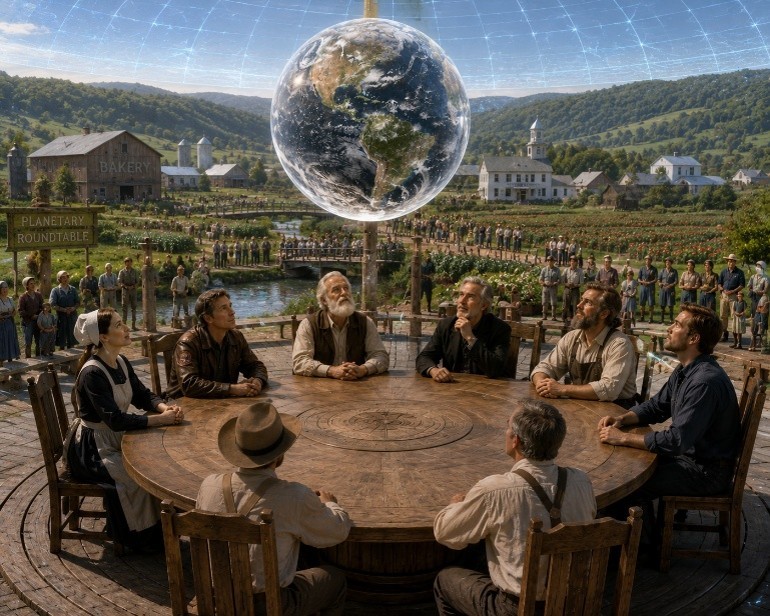
The four-foot crystal Earth was raised above the Planetary Roundtable before breakfast.
There was no procession this time.
No oversized wagon.
No reinforced bridges.
No eight-horse team straining against leather harness.
The smaller orb traveled from the glassworks in a padded wooden cradle drawn by two steady horses. Jake walked beside it with one hand resting on the frame, less from necessity than habit.
The first Earth had required half the settlement to move.
The second arrived quietly.
By midmorning, it floated above the center of the Roundtable.
Four feet in diameter.
Large enough to command attention.
Small enough that the people seated beneath it could still see one another.
The eight-foot prototype had returned to the glassworks, where apprentices studied its flawless surface and Jake used it to explain that good craftsmanship was not the same thing as a finished idea.
The new orb belonged here.
The Planetary Roundtable stood in the open valley with no walls, doors, or guarded entrance. Broad paths approached from every direction. Grassy terraces rose around the circular platform, allowing anyone in the settlement to watch, listen, or join the conversation.
The soft daylight of the Glove spread evenly across the fields.
No sun hung in the sky.
No shadows traveled from east to west.
The valley simply rested beneath the familiar illumination that had followed the Earth beyond its old orbit.
Families gathered along the terraces.
Farmers came from the fields.
Milkmaids arrived from the dairy.
Glassworkers stood together near Jake.
Children occupied the front rows until Rebecca noticed that several had quietly moved closer to the table.
She let them stay.
Samuel Yoder stood beneath the orb with Rebecca at his side.
Buck Rogers carried his clipboard.
Galileo Maestro rested both hands on the back of an empty chair.
Elias Hawking studied a small instrument attached beneath the table.
Jake stood where he could see the orb and the people at the same time.
Nord sat among the crowd.
Samuel glanced toward him.
“You’re welcome at the table.”
Nord smiled.
“I know.”
He looked around at the people gathering on the grass.
“That is why I am sitting here.”
Samuel nodded.
No one announced the beginning.
There was no bell.
No ceremony.
The Roundtable had not been built to impress people with ceremony.
It had been built so they could gather.
When the conversations quieted, Samuel removed his hat and laid it on the table.
The crystal Earth floated several feet above them.
Clear.
Silent.
Reflecting the valley in its curved surface.
Samuel looked at the people seated around the table.
“The first Earth taught us something.”
Jake folded his arms.
“It taught Buck that Kentucky can move faster than he can.”
Buck nodded gravely.
“I’m still looking for the schoolhouse.”
Laughter moved through the crowd.
Samuel smiled.
“It taught us that something can be beautiful, strong, and perfectly made…”
He looked upward.
“…and still not be right for its purpose.”
Jake nodded.
No embarrassment crossed his face.
Only pride.
Samuel continued.
“This one was built differently.”
“Not to dominate the table.”
“Not to hide the people seated across from us.”
“It was built to serve the gathering.”
Rebecca looked beneath the orb toward Galileo on the opposite side.
For the first time, she could see his face without leaning to one side.
“So far,” she said, “it is doing better.”
Galileo smiled.
Elias straightened.
“There is one more thing to learn.”
Buck tapped his pencil against the clipboard.
“What does it do?”
Elias looked toward the orb.
“That depends upon what we ask.”
Buck glanced at Galileo.
“I thought this was supposed to make things easier.”
“It may,” Galileo said. “Once we learn not to ask it to think for us.”
Samuel rested one hand on the oak table.
“The Glove has protected the Earth since we left the Sun.”
“It provides our light.”
“It maintains the air, the water, and the conditions that allow us to live.”
He paused.
“But the Glove is not our ruler.”
“It does not decide what kind of people we should become.”
“It can show us what it knows.”
“What we do with that knowledge remains ours.”
A child near the front raised her hand.
Rebecca recognized her from the schoolhouse.
Samuel smiled.
“You have a question?”
“Does it talk?”
Several adults looked toward Elias.
He shook his head.
“Not the way we talk.”
The girl studied the clear orb.
“How will we know what it says?”
Galileo answered.
“By paying attention.”
The child seemed satisfied with that.
Samuel looked upward.
“The Glove.”
Nothing happened.
No voice answered.
No greeting welcomed them.
The valley remained still.
Then a tiny point of light appeared deep within the crystal.
It brightened slowly.
Pale blue spread through the orb.
Continents emerged.
Oceans deepened.
Clouds formed in soft white spirals.
The clear sphere became the Earth.
A murmur moved through the terraces.
Several children rose to their feet.
The globe turned slowly above the table.
Every person seated beneath it could see across to the opposite side.
No faces disappeared behind it.
No one needed to stand.
Jake watched the crowd.
Galileo noticed.
“You’re watching the people.”
Jake nodded.
“I already know the glass works.”
Samuel looked into the globe.
“Show us our valley.”
The Earth enlarged.
North America appeared.
Kentucky emerged.
The image descended through the even cloud cover until the valley filled the crystal.
The settlement appeared in miniature.
The bakery.
The creamery.
The glassworks.
The sawmill.
The dairy barn.
Rebecca’s kitchen.
The schoolhouse.
The rows of worker cabins.
The broad fields stretching beyond them.
A tiny wagon moved along the road.
Children pointed.
“That’s Isaac’s wagon.”
“No, it’s the dairy wagon.”
“It’s going the wrong way for the dairy.”
Buck leaned forward.
“That is Isaac’s wagon.”
A few people laughed.
The image rotated gently, but the settlement remained visible from every side. The Glove did not merely wrap one picture around the sphere. It adjusted the view so those seated around the table could follow the same place from their own position.
Elias looked toward Galileo.
“That is new.”
“No,” Galileo said. “That is what the larger orb was trying to tell us.”
Samuel studied the image.
“Show us the settlement from above.”
The view rose.
Fields spread across the orb.
Roads formed a rough web between the buildings.
The Roundtable appeared near the center, surrounded by the workshops and homes that had grown around it.
Rebecca pointed toward the kitchen.
“That roof needs attention.”
Buck followed her finger.
“You can see that from here?”
“The west corner is darker.”
Elias leaned closer.
The image enlarged.
Several shingles had lifted near the chimney.
Rebecca looked toward Samuel.
“I’ve been telling you.”
Samuel kept his eyes on the orb.
“I was waiting for scientific confirmation.”
The laughter reached the upper terraces.
Buck wrote something on his clipboard.
Rebecca watched him.
“What are you writing?”
“Roof.”
“Underline it.”
Buck underlined it twice.
The image waited.
It did not suggest a carpenter.
It did not assign a crew.
It showed only what was there.
Rebecca looked upward.
“Show us the food growing in the valley.”
The view changed.
Fields glowed in subtle shades.
Tomatoes formed long bands of deep green.
Corn appeared in lighter rows.
Orchards shimmered around clusters of fruit.
The dairy pasture carried a soft blue tint.
Storage buildings brightened with small points of light.
Rebecca studied the display.
“What does the blue mean?”
The image moved closer to the dairy pasture.
Moisture appeared beneath the soil as faint shifting lines.
She nodded.
“Water.”
Then part of the tomato field dimmed.
A narrow patch near the southern edge had begun to dry.
Amos Kline stood from the terraces.
“I checked that field yesterday.”
Elias looked toward him.
“What did you see?”
“Nothing from the road.”
The orb enlarged the area.
A shallow channel beneath the soil had collapsed, diverting water away from several rows.
Amos studied it.
“I’ll take two men after dinner.”
The orb made no recommendation.
It had shown the condition.
Amos supplied the judgment.
Samuel noticed Galileo smiling.
“What?”
“The answer was not in the globe,” Galileo said.
He nodded toward Amos.
“It was in the man who understood what he was seeing.”
Buck stepped closer to the table.
“My turn.”
Rebecca folded her arms.
“This should be interesting.”
Buck ignored her.
“What do we know about the visitors expected tomorrow?”
The valley faded.
Stars filled the orb.
Three small points appeared beyond the Earth.
Each traveled along a gentle path toward the planet.
Then images formed.
A Nordic vessel.
Crates of woven material.
Packets of seed.
Metal tools of unfamiliar design.
Previous meetings.
Food changing hands.
People seated together.
The images moved without narration.
No symbol declared the visitors friendly.
No warning called them dangerous.
Buck waited.
Nothing more appeared.
“That’s it?”
Elias nodded.
“That is what it knows.”
Buck looked toward the orb again.
“Should we trust them?”
The stars continued to turn.
No image appeared.
No light changed.
The Glove remained silent.
Buck glanced at Samuel.
“Did I ask it wrong?”
Galileo shook his head.
“You asked it to decide.”
Buck considered that.
Then tried again.
“What has happened during previous meetings with these visitors?”
The orb responded.
Images appeared.
Nordics unloading woven fabric.
Earth workers exchanging preserved food.
A disagreement over measurements.
Galileo correcting a scale.
Rebecca handing a visitor a tomato.
The visitor taking one bite and immediately requesting an entire crate.
Laughter moved through the Roundtable.
The images continued.
A damaged wagon wheel repaired by both groups.
A meal shared beside the bakery.
Visitors departing peacefully.
Then the orb returned to the stars.
Buck nodded.
“That’s useful.”
“It gave you facts,” Elias said.
“It left you the responsibility of judgment.”
Buck looked toward Samuel.
“Do we trust them?”
Samuel watched the three approaching lights.
“We prepare a welcome.”
“That isn’t the same thing.”
“No.”
Samuel smiled.
“But it is where trust begins.”
Nord rose from his place among the crowd.
“The Glove did not show you every conversation.”
Buck turned toward him.
“Why not?”
“Because not every conversation was observed.”
The orb remained unchanged.
Elias nodded.
“Then it admits what it doesn’t know.”
Galileo glanced upward.
“By showing nothing.”
Buck tucked the pencil behind his ear.
“I’m beginning to appreciate silence.”
Rebecca looked at him.
“We’ll remind you of that.”
The children laughed louder than the adults.
Jake stepped toward the table.
“I have a question.”
Everyone turned toward him.
He looked up at the crystal Earth his workers had made.
“Show us the glassworks.”
The stars faded.
The factory appeared.
Furnaces glowed within the orb.
Workers moved between the ovens.
Jars traveled along the cooling lines.
Window glass rested in upright racks.
Jake watched carefully.
“Show the annealing ovens.”
The image moved closer.
One oven appeared brighter along a narrow section near its far end.
Jake leaned forward.
“There.”
Elias saw it.
“Uneven temperature?”
Jake nodded.
“We’ve lost three batches from that line this week.”
The orb showed the heat spreading poorly through one section of the brickwork.
Jake smiled.
“I thought the problem was the rollers.”
Buck looked toward him.
“What will you do?”
“Remove the outer brick.”
“Replace the insulation.”
“Reset the air channel.”
The globe offered no instructions.
Jake already knew the work.
Samuel looked around the table.
“The Glove can show Jake the heat.”
“But Jake knows the furnace.”
Jake nodded.
“A tool doesn’t replace the craftsman.”
“It gives the craftsman better eyes.”
The image of the glassworks faded.
For several moments no one asked another question.
The crystal Earth turned slowly above them.
The people on the terraces whispered among themselves.
A woman from the creamery stood.
“Can it show whether milk has spoiled?”
Elias considered the question.
“Perhaps.”
She looked toward the orb.
“Show us the milk stored in the creamery.”
The creamery appeared.
Rows of bottles brightened.
Most remained clear.
Three bottles near the rear wall developed a faint amber glow.
The woman frowned.
“Those came from yesterday’s evening milking.”
Rebecca looked toward her.
“What will you do?”
“Open one.”
“Smell it.”
“Taste it.”
“And if it’s bad?”
“Feed it to the hogs if it is safe for them.”
Again, the orb supplied information.
The people supplied understanding.
The questions continued.
A farmer asked about the soil beneath a field.
A carpenter asked about the strength of a roof beam.
The schoolteacher asked to see the old path of the Earth around the Sun.
The orb displayed the former orbit as a thin glowing circle.
Then it showed the Earth’s present course through space.
The two paths separated.
The children stared.
One boy raised his hand.
“Are we lost?”
No one laughed.
Samuel looked at the child.
Before he could answer, the boy looked toward the orb.
“Does the Glove know where we’re going?”
Nothing appeared.
The stars remained still.
Elias spoke gently.
“It may know our direction.”
“But that is not the same as knowing our destination.”
The boy thought about that.
“Are you scared?”
Elias looked toward Samuel.
Samuel answered.
“No.”
The boy waited.
Samuel looked across the fields, workshops, and homes surrounding the Roundtable.
“The Earth has always traveled through space.”
“We noticed it less when it followed the same path every year.”
He glanced toward the crystal globe.
“Now it follows a different path.”
The child looked upward.
“That’s all?”
“That is enough.”
Rebecca watched the boy settle back onto the grass.
Galileo studied Samuel.
“You answered a judgment.”
Samuel smiled.
“The boy didn’t ask the Glove.”
The orb continued to turn.
By midday, the first gathering had become less a demonstration than a lesson in asking.
People discovered that broad questions produced broad images.
Precise questions revealed details.
Questions about what existed received answers.
Questions about what ought to be done returned silence.
No one found the silence insulting.
In time, they began to understand it as a boundary.
The Glove could inform wisdom.
It could not become wisdom for them.
Rebecca was the first to suggest ending the gathering.
“People still need dinner.”
The orb displayed nothing.
Buck looked up.
“At least it knows better than to argue with Rebecca.”
Samuel stood and placed his hat on his head.
The images within the crystal slowly faded.
Fields dissolved.
Stars vanished.
Oceans became clear glass.
The orb returned to reflecting the people seated beneath it.
For a moment, Samuel saw Rebecca’s face curved across its surface.
Then Buck.
Galileo.
Elias.
Jake.
Nord among the crowd.
Children on the grass.
Farmers standing at the edges of the platform.
The entire settlement seemed gathered inside the crystal.
Jake noticed it too.
“The first Earth reflected the factory,” he said.
“This one reflects the people.”
Galileo looked around the open Roundtable.
“As it should.”
The crowd began to disperse along the many paths.
No doors opened.
No guards dismissed them.
They simply returned to their work carrying new questions.
Buck remained beside the table, studying his clipboard.
Samuel glanced over his shoulder.
“What are you writing now?”
Buck turned the page so Samuel could see.
At the top he had written:
Questions the Glove answered.
Below it:
Questions we must answer ourselves.
Samuel nodded.
“Keep both lists.”
Buck looked toward the silent orb.
“I suspect the second one will be longer.”
Galileo joined them.
“It should be.”
Above the Roundtable, the four-foot Earth floated quietly in the gentle light of the Glove.
It had shown them fields, furnaces, visitors, milk, soil, and stars.
It had not told them whom to trust.
It had not chosen their work.
It had not explained where their journey would end.
The orb had given them no commandments.
No promises.
No comforting certainty.
It had offered something more useful.
A clearer view.
And beneath it, gathered around an open table where anyone could listen, the people of the valley began learning what to do with what they could see.