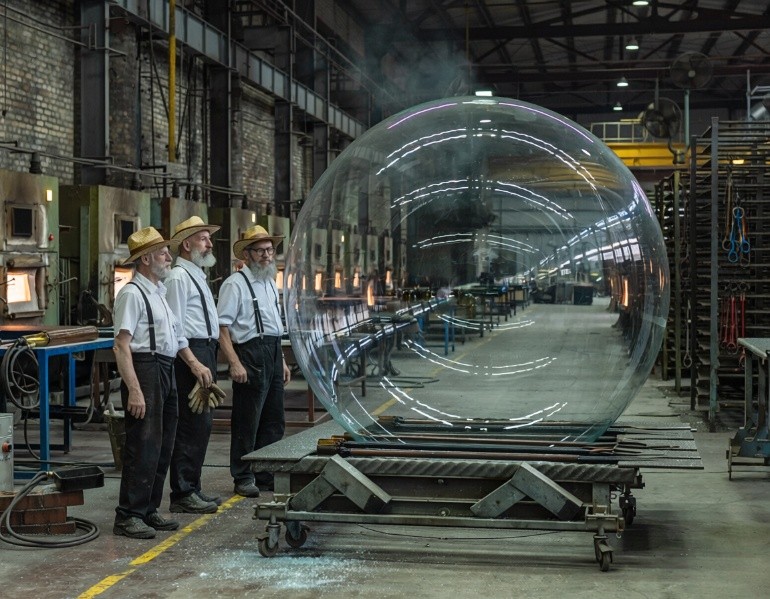
Word of the floating Earth traveled through the settlement before breakfast.
By the time Rebecca rang the morning bell, nearly everyone already knew.
The great crystal sphere had been lifted above the Planetary Roundtable.
It floated without chains.
Without cables.
Without any visible support.
Children repeated the story to one another with growing improvements. By the time the schoolhouse opened, the orb was said to have risen by itself, turned toward Saturn, and winked at Buck Rogers.
Buck denied only the winking.
The Planetary Roundtable stood in the open air at the center of the valley. No walls concealed it. No doors guarded its entrance. Broad paths approached from every direction, and grassy slopes surrounded the circular platform so that anyone could sit and observe.
Above the center of the great oak table floated the crystal Earth.
Eight feet in diameter.
In the soft, even daylight provided by the Glove, its polished surface reflected the surrounding valley. Barn roofs curved across it. Fields rolled over its transparent surface. People approaching along the paths appeared briefly upside down before sliding around the sphere and disappearing.
Long before the demonstration began, families had gathered on the grass.
Farmers came directly from the fields.
Milkmaids arrived in aprons.
Glassworkers stood together near Jake.
Children settled wherever they could see, although several had already discovered that the best view depended upon which part of the Earth they wished to examine.
Samuel stood beside the Roundtable with Rebecca.
Buck Rogers held his clipboard beneath one arm.
Galileo Maestro and Elias Hawking quietly inspected the orb from opposite sides.
Jake looked upward with the expression of a man still not entirely convinced that the enormous piece of glass above him had once rested inside his factory.
Nord stood among the visitors rather than beside the table.
Samuel noticed.
“You could sit with us.”
Nord smiled.
“Today I would rather watch your people.”
Samuel looked across the growing crowd.
“I believe that may be the more interesting view.”
Rebecca glanced toward the children moving around the platform.
“They’ve already circled it three times.”
“They’re studying geography,” Samuel said.
“They’re chasing their reflections.”
“That may be geography at their age.”
Rebecca smiled.
When the last of the morning workers had found places on the grassy slope, Samuel stepped forward.
Conversation quieted.
He removed his hat.
“We built this table so that no person would have to stand outside a closed door while decisions were being made.”
He looked around the open valley.
“There is no inside here.”
“There is no outside.”
“There is only the table and everyone willing to gather around it.”
The words carried easily through the still air.
Samuel looked up at the floating sphere.
“This Earth was shaped by the glassworkers.”
“Moved by the teamsters.”
“Lifted by the riggers.”
“Supported by work from nearly every shop in the settlement.”
He glanced toward Jake.
“But making something beautiful is not the same as understanding what it can do.”
Jake nodded.
Samuel turned toward Elias.
“I believe that part belongs to you.”
Elias stepped to the table.
There were no switches on its surface.
No wires.
No control panel.
Only oak worn smooth beneath the hands of the men who had built it.
Elias placed his palm against the wood.
“The Glove has been with us since the Earth left its orbit,” he said. “It surrounds us. It gives us light. It protects the world. It observes more than any person could observe.”
He looked toward the crowd.
“But it does not rule us.”
“It does not decide for us.”
“It can show us what it knows.”
“What we understand from that knowledge remains our responsibility.”
Buck shifted his clipboard beneath his arm.
“That sounds suspiciously like work.”
“It is,” Elias said.
A few people laughed.
Then the Roundtable became quiet.
Elias looked toward the orb.
“The Glove.”
Nothing happened.
No voice answered.
No greeting came from the crystal.
A faint point of light appeared deep inside the sphere.
It spread slowly outward.
The clear glass filled with pale blue.
Continents emerged.
Oceans deepened.
White clouds curled across the surface.
The great sphere became an Earth suspended above the table.
A murmur moved through the crowd.
Children rose to their feet.
Rebecca stared upward.
Though she had watched the orb being raised the previous day, this was no longer merely glass.
It seemed alive.
Not alive as a creature was alive.
Alive with motion.
Alive with information.
Alive with the memory of a world.
Galileo watched the people.
Jake watched the glass.
Buck watched both.
Samuel spoke first.
“Show us our valley.”
The image changed.
The Earth enlarged until North America filled one side of the orb.
Kentucky appeared.
The view descended through the clouds.
Mountains spread across the curved surface.
Rivers brightened.
Then the valley emerged.
The Roundtable itself appeared near the center of the image, surrounded by workshops, fields, barns, cabins, and roads.
The crowd leaned forward.
“There’s the dairy,” Rebecca said.
A group of milkmaids moved to her side of the table.
“I can’t see it,” someone called from the opposite side.
“You’ll have to come around.”
Several people began walking.
Buck stepped aside as three children hurried past him.
A farmer pointed toward the sawmill, only to lose sight of it when the image rotated around the globe.
“Hold it there,” he called.
The sphere continued its slow turn.
Elias studied it.
“I don’t believe it understands ‘hold it there’ without knowing what you mean by ‘there.’”
The farmer walked around the table to follow the sawmill.
More people moved with him.
Rebecca found the kitchen.
Then lost it.
Buck walked halfway around the orb and stopped.
“I’ve misplaced the entire settlement.”
“It’s behind you,” Jake said.
Buck turned.
“That's not where I left it.”
Laughter moved through the crowd.
Samuel smiled, but Galileo remained silent.
He had not taken his eyes from the people surrounding the table.
Rebecca stepped closer.
“The Glove, show us the food being produced in the valley.”
The view changed again.
Fields glowed in soft variations of green and gold.
Orchards shimmered.
The dairy and creamery brightened.
Storage buildings appeared as small points of light.
Rebecca circled the table, studying each section.
Women from the kitchen followed her.
Farmers moved in the opposite direction, trying to see the fields.
Children slipped between adults.
The demonstration became a slow-moving procession around the orb.
No one complained.
The sight was too remarkable for complaint.
Yet no one remained still.
Buck finally found a place beside Elias.
“My turn?”
Elias gestured toward the sphere.
Buck looked up.
“What do we know about the visitors expected tomorrow?”
The valley disappeared.
Stars filled the crystal.
Three points of light appeared beyond the Earth.
Each followed a curving path toward the planet.
Then images formed across the sphere.
A Nordic vessel.
Crates of woven fabric.
Seeds arranged in small packets.
Earth vegetables being examined by unfamiliar hands.
No judgment accompanied the pictures.
No declaration of friendship.
No promise of safety.
Only what had been observed.
Buck moved around the table to follow one of the vessels as it disappeared across the far side.
Nord walked the opposite way.
The two nearly collided.
“Excuse me,” Buck said.
“You are excused.”
Buck stopped.
He looked around.
Nearly everyone had changed position.
Some stood on the platform.
Others had moved down the paths.
Children were circling the Roundtable as if the crystal Earth were the center of a game.
Galileo finally spoke.
“Interesting.”
Buck looked toward him.
“What is?”
Galileo did not answer immediately.
He walked away from the table and climbed several steps up the grassy slope.
From there he watched the entire gathering.
“Continue,” he said.
Jake folded his arms.
“That sounded ominous.”
Rebecca looked toward the orb.
“The Glove, show us the dairy herd.”
The image descended into the valley again.
Cattle appeared across one side of the sphere.
The milkmaids hurried toward that side.
Farmers shifted to make room.
A group of children ran around the opposite edge.
Someone called out that the barn was visible.
Half the crowd moved.
The barn vanished around the curve.
Galileo raised one hand.
“Stop.”
No one knew whether he was speaking to the Glove or the people.
Both became still.
The image of the dairy herd remained across the orb.
Galileo descended the slope.
He walked slowly toward the Roundtable.
“What did you see?” Samuel asked.
“People learning,” Galileo replied.
Jake smiled.
“Then it works.”
“It works beautifully.”
Jake waited.
Galileo looked up at the massive sphere.
“It may be the finest globe ever made.”
“That still sounds like praise.”
“It is praise.”
Galileo placed his hands upon the edge of the table.
“But no one has remained in the same place for more than a minute.”
The people surrounding the Roundtable looked at one another.
Buck glanced down at his boots, as though surprised to discover where they had carried him.
Rebecca looked across the table toward the milkmaids.
Galileo continued.
“Every image has another side.”
“If Rebecca studies the dairy, Samuel sees the mountains beyond it.”
“If Buck follows a visitor’s ship, Nord must walk the opposite direction to see where it came from.”
“The orb shows everything.”
He paused.
“But not to everyone at once.”
Elias looked upward.
The observation settled heavily upon him.
“I designed it to reproduce the Earth.”
“You succeeded,” Galileo said.
“Perhaps too well.”
Jake slowly walked around the sphere.
“What would you change?”
Galileo smiled.
“I would not begin with the Earth.”
He looked around the table.
“I would begin with the people.”
No one spoke.
He pointed toward the gathering.
“The Earth is not the audience.”
“The people are.”
Samuel studied the orb.
“So the problem is its size?”
“Not merely its size,” Galileo said. “Its purpose.”
Elias nodded slowly.
“We built something to be admired from a distance.”
Rebecca looked toward the children.
“But people must gather close enough to learn from it.”
Buck removed his pencil from behind his ear.
“How close?”
Elias began calculating in the margin of Buck’s clipboard.
Jake watched him.
“Half the diameter?”
Elias nodded.
“Four feet.”
Buck looked from the figures to the orb.
“That seems small after looking at this one.”
“It will still be larger than any ordinary globe,” Galileo said. “But people seated around the table will be able to see above it, beneath it, and across it.”
Rebecca considered that.
“The children could remain seated.”
“And everyone could follow the same image,” Elias said.
Jake gazed at the orb he had labored so long to create.
No one spoke to him.
No one needed to.
He had built exactly what they had asked him to build.
Perfectly.
Samuel stepped beside him.
“It is not a failure.”
Jake looked at Samuel, then back at the great crystal Earth.
“No.”
A smile slowly reached his face.
“It is a prototype.”
Elias folded the corner of Buck’s paper and began sketching a smaller sphere.
Jake leaned closer.
“Four feet?”
“Four feet.”
“Thinner walls?”
“Most likely.”
“Different mold.”
“Yes.”
Jake rubbed his hands together.
“The furnace will be easier.”
Buck raised an eyebrow.
“That means it won’t take another two weeks?”
Jake looked at him.
“I said easier.”
“I didn’t say easy.”
The crowd laughed.
The tension dissolved.
Children resumed moving around the orb.
A few farmers remained where they were, experimenting with what could be seen from different positions.
Rebecca walked to Galileo.
“What do we do with this Earth?”
Galileo studied the eight-foot sphere.
“We let it continue teaching us.”
“Where?”
Jake answered before Galileo could.
“At the glassworks.”
Everyone turned toward him.
“It belongs where the apprentices can study it,” Jake said. “They should see what their hands made.”
He smiled.
“And they should learn that a masterpiece can still be improved.”
Samuel nodded.
“Then it will go home.”
Jake looked at the crystal Earth above the Roundtable.
“No.”
“It will go to work.”
By midday, the demonstration had become an experiment.
Buck marked viewing positions around the table.
Rebecca seated children at different distances and asked what they could see.
Elias measured angles.
Galileo watched how people gathered.
Jake examined the orb’s thickness, curvature, and clarity.
Nobody mourned the change.
The great Earth had done exactly what a good prototype should do.
It had revealed the weakness hidden inside a beautiful idea.
Late in the afternoon, the image within the sphere faded.
Continents dissolved.
Oceans became clear glass.
The orb returned to reflecting the valley around it.
The crowd slowly dispersed.
Some returned to the fields.
Others to the shops.
Children lingered longest.
Samuel stood with Rebecca near the edge of the Roundtable.
Above them, the eight-foot Earth remained suspended in silence.
Rebecca looked toward Jake, Elias, Buck, and Galileo gathered over a fresh drawing.
“They’ve already begun.”
Samuel smiled.
“That is what people do when they are not afraid of being wrong.”
At the worktable, Jake drew a circle four feet across.
Elias added measurements.
Buck listed the crews they would need.
Galileo wrote only one sentence at the top of the page.
Build it for the people.
The first Earth had been beautiful.
The second would be useful.
And in the valley, usefulness was considered a beauty of its own.