More Than a Recipe
The remaining gold arrived shortly after breakfast.
Gaddy stood beside the Planetary Roundtable while Buck Rogers and Samuel Yoder watched two Anunnaki attendants carry several heavy containers through the open entrance.
The crystal orb floated above the table, displaying the pantry inventory in neat numbered sections.
Buck opened the first container.
Inside, quarter-ounce gold coins rested in closely packed rows. Each coin bore the stamped number five.
Buck lifted one and turned it beneath the light.
“Same weight and purity as the deposit?”
Gaddy folded both hands behind Gaddy’s back.
“Exactly the same.”
Buck passed the coin to Elias Hawking.
Elias placed it on a small balance scale, added measured weights, and nodded.
“Quarter ounce.”
Buck looked toward the remaining containers.
“Then we count them.”
Gaddy glanced toward the pantry glowing beneath the orb.
“That will take time.”
Buck smiled.
“So did filling the pantry.”
No one hurried.
The coins were counted into groups, weighed, and counted again. Galileo Maestro entered the figures through the Roundtable controls while Elias verified the total.
When the last coin had been accepted, the remaining auction lots changed color beneath the orb.
SOLD.
PAID.
READY TO LOAD.
Buck closed the ledger.
“Three thousand quarter-ounce gold coins received.”
Gaddy looked toward the illuminated inventory.
“Then everything belongs to me.”
“Everything marked for sale,” Buck corrected.
Gaddy’s gaze moved toward the pasture beyond the Roundtable.
“The elephants remain excluded?”
Mike, standing outside beside Jumbo, answered without turning around.
“They remain family.”
Gaddy looked toward Samuel.
“And the horses?”
“Also family,” Samuel said.
Gaddy studied the people around the table.
“You make unusual distinctions between property and value.”
Samuel smiled.
“Some things are valuable because they can be sold.”
He looked toward the pasture.
“Others are valuable because they cannot.”
Buck tucked the ledger beneath one arm.
“Now that the account is settled, we can finish loading.”
The valley became a river of wagons.
Teams moved steadily between the pantry and the Anunnaki ships waiting beyond the fields.
Each wagon carried numbered lots.
Each lot traveled with a loading ticket.
Nothing left the pantry until the number, count, weight, and payment had been checked.
At the ship, the process happened again.
Count.
Inspect.
Load.
Record.
The loading crews quickly found their rhythm.
Heavy canned goods and bottled water went into the lower cargo holds. Flour, cornmeal, and oats were stacked where they would remain dry. Glass jars and windows received wooden bracing built by the carpenters. Cheese, butter, canned meats, honey, and cured foods were placed according to the temperature requirements Elias had established with the Anunnaki crew.
Buck moved constantly.
He checked wagon numbers.
He compared tickets against the ledger.
He climbed loading ramps.
He inspected braces.
He asked questions nobody else had thought to ask.
“How much weight is already on that side?”
“Who counted those crates?”
“Where is Lot Twenty-Seven?”
“Why is that wagon waiting?”
Whenever an answer did not satisfy him, nothing moved until it did.
Gaddy watched from the loading platform.
At first, Gaddy had expected the movement of so many wagons, workers, crates, and ships to produce confusion.
Instead, the operation grew smoother as the day continued.
Every person understood the next task.
No crate disappeared.
No lot became mixed with another.
No worker searched for a shortcut.
Gaddy’s plan had depended upon disorder.
Earth answered with organization.
By midday, Gaddy no longer looked for an opening.
Gaddy watched the humans keep their word.
Across the valley, Zeta, Orin, Sela, Nek, and Tavi stood beside two patient draft horses.
Five pairs of new leather work boots had already acquired a coat of dust.
Jacob Yoder walked around the team, checking each strap of the harness.
“The first thing to remember,” Jacob said, “is that the horse knows more about pulling a plow than any of you.”
Orin examined the traces.
“Then why does the horse require a farmer?”
“To decide where the furrow belongs.”
Jacob placed a hand against the mare’s neck.
“But deciding where to go does not make you the stronger partner.”
Nek stepped closer.
The mare turned and breathed against Nek’s shoulder.
Nek froze.
Jacob smiled.
“She’s learning your smell.”
“What should Nek do?”
“Stand still.”
Nek remained motionless.
The mare sniffed again, then lowered the head.
Jacob nodded.
“Now scratch beneath the jaw.”
Nek raised one narrow hand and gently rubbed the mare.
The horse relaxed.
“Trust begins before the harness,” Jacob said.
Zeta watched every movement.
“How long before the horse obeys?”
Jacob looked toward Zeta.
“If obedience is all you want, you’re asking the wrong question.”
“What should Zeta want?”
“A willing partner.”
Jacob handed the reins to Zeta.
“Speak before touching. Watch the ears. Never surprise a horse from behind. Keep your hands steady. If you become frightened, the horse will know before you admit it.”
Zeta studied the team.
“The horse reads thoughts?”
“No.”
Jacob smiled.
“Just people.”
He guided Zeta into position behind the plow.
“Hold the handles firmly, but don’t wrestle them.”
Zeta wrapped both hands around the polished wood.
Jacob passed the lines over one shoulder.
“Now tell the team to walk.”
Zeta repeated the command Jacob had taught.
The horses leaned forward.
Leather tightened.
The plow point entered the earth.
Zeta’s first furrow wandered sharply to the left.
Jacob said nothing.
Zeta pulled the plow in the opposite direction.
The furrow wandered right.
At the far end of the field, Jacob stopped the team.
Zeta turned and examined the crooked trail.
“That is not straight.”
“No,” Jacob agreed.
“Did Zeta fail?”
Jacob took the plow handles.
“You turned soil that had not been turned before.”
He looked along the uneven row.
“That is never failure.”
On the second pass, Jacob walked beside Zeta.
“Look toward where you want to finish. Don’t stare at the plow.”
Zeta lifted Zeta’s gaze toward a fence post at the far end of the field.
The horses moved.
The plow followed.
The second furrow still curved, but less than the first.
Orin, Sela, Nek, and Tavi each took a turn.
Orin studied the mechanics of the plow and tried to understand every vibration through the handles.
Sela stopped frequently to examine the newly exposed soil.
Nek spoke softly to the horses and earned an approving flick of their ears.
Tavi concentrated so fiercely on walking straight that Tavi stepped into the previous furrow and nearly fell.
Jacob caught Tavi by one suspender.
“Farmers generally remain above the ground until planting.”
The Greys looked toward one another.
Then, almost together, they laughed.
By afternoon, several rough furrows stretched across the field.
They were not beautiful.
They were not straight.
But the soil had been opened.
Jacob knelt and lifted a handful.
“This is what you’re really learning.”
Zeta crouched beside him.
“To move dirt?”
“To prepare a place where life can begin.”
The dark soil crumbled between Jacob’s fingers.
“Plowing loosens the ground. It turns under what remains from the last crop. It lets air and water reach deeper. Later we break the clods, add compost, level the bed, and decide what the soil is ready to grow.”
Zeta touched the earth.
“What if our home soil cannot grow anything?”
“Then you learn why.”
Jacob closed his hand around the soil.
“Too much clay can be improved. Sand can be strengthened. Poor ground can be fed. Wet ground can be drained. Dry ground can be watered.”
“And if none of that succeeds?”
“Then you haven’t wasted your time.”
Zeta tilted Zeta’s head.
“You’ll know what your world needs.”
Beyond the field, another loaded wagon disappeared through the open cargo door of Gaddy’s ship.
Zeta watched it for a moment.
“That ship carries enough food to sustain many.”
Jacob stood and brushed the soil from his knees.
“For a while.”
Zeta looked back at the furrows.
“This could sustain them longer.”
Jacob smiled.
“Now you’re thinking like a farmer.”
By evening, the last numbered lots had left the pantry.
Buck stood at the base of the loading ramp while the final crate crossed into the cargo hold.
“Lot Forty-Two,” the loader called.
Buck checked the ledger.
“Count?”
“Complete.”
“Condition?”
“Accepted.”
“Payment?”
“Received.”
Buck drew the last line through the manifest.
The orb at the Roundtable changed the final lot from PAID to LOADED.
Gaddy looked at the completed record.
“No errors?”
“None that left the ground,” Buck answered.
Gaddy looked toward the ships, now heavy with Earth’s produce.
“My people will remember this shipment.”
Buck closed the ledger.
“Then remember that you received exactly what you bought.”
Gaddy nodded.
“And remember,” Samuel added, “that the pantry can be filled again.”
Gaddy looked across the valley.
Horses were already turning soil for another crop.
Seedlings waited inside the greenhouse.
Workers moved compost toward the fields.
The sale had emptied shelves.
It had not diminished Earth.
Gaddy finally understood the difference.
Rebecca appeared near the plowed field carrying a wooden pizza peel over one shoulder.
“Zeta!”
Five Grey heads turned.
Rebecca laughed.
“I meant the whole crew.”
Zeta, Orin, Sela, Nek, and Tavi followed Rebecca toward the kitchen.
Their new boots were dusty.
Their shirts carried streaks of soil.
Tavi still had a small clod of earth caught in one suspender.
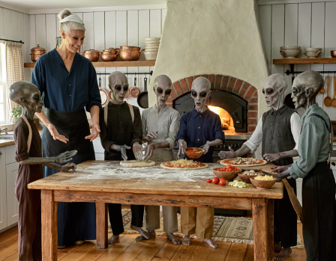
Inside the kitchen, flour covered the long wooden worktable.
Five balls of dough rested beneath clean cloths.
Bowls held fresh tomato sauce, shredded cheese, peppers, onions, mushrooms, herbs, bacon, ham, pepperoni, and Italian sausage.
The brick oven glowed warmly at the far end of the room.
Zeta examined the ingredients.
“Is this additional agricultural instruction?”
Rebecca tied an apron around Zeta.
“Everything in this kitchen began in a field.”
Zeta considered the answer.
“Then yes.”
Rebecca placed dough before each Grey.
“Tonight you’re learning what happens after the harvest.”
Orin pressed the dough too hard and forced it into a long narrow shape.
Sela added so much sauce that it escaped over every edge.
Nek stopped repeatedly to ask which animal had produced each meat.
Tavi arranged toppings in separate territories that never touched.
Zeta created a nearly perfect circle and placed each ingredient with exact symmetry.
Rebecca looked over the five pizzas.
“You’re all thinking too much.”
Zeta looked down at Zeta’s careful arrangement.
“Is accuracy undesirable?”
“Not at all.”
Rebecca lifted a handful of cheese and scattered it loosely over Zeta’s pizza.
“But supper shouldn’t look frightened.”
Mike appeared in the doorway.
He examined the five creations.
“One of those looks like a map.”
Tavi pointed toward the divided toppings.
“It represents efficient allocation.”
Mike nodded.
“Of pepperoni?”
“Yes.”
“Carry on.”
Rebecca slid the pizzas into the oven.
Within minutes, the smell of baking dough, tomatoes, cheese, herbs, and cured meat filled the kitchen.
Buck followed the aroma through the doorway.
“I thought the workday was over.”
Rebecca looked toward him.
“This is the reward.”
The pizzas emerged one at a time.
Crusts had browned.
Cheese bubbled.
Edges crackled beneath Rebecca’s knife.
Rebecca handed the first slice to Zeta.
Zeta took a bite.
For several moments Zeta said nothing.
Rebecca waited.
“Something wrong?”
Zeta looked at the slice.
“Our food pellets contain measured nutrients.”
Rebecca nodded.
“They keep us alive.”
Another nod.
“But they do not create anticipation.”
Rebecca leaned against the table.
“What does?”
Zeta looked around the kitchen.
Orin was laughing at the narrow pizza.
Sela was wiping spilled sauce from the table.
Nek had already begun a second slice.
Tavi was explaining efficient pepperoni allocation to Mike.
Samuel stood quietly beside the doorway while Jacob brushed field dust from his hat.
“The smell before eating,” Zeta said.
“The work of making it.”
“The people waiting together.”
“The memory afterward.”
Zeta studied the pizza again.
“The food is only part of the meal.”
The kitchen became still.
Samuel smiled.
“What is the rest?”
Zeta looked from Rebecca to the four Grey companions.
“Everything that brought us to the table.”
No one answered immediately.
Outside, the Anunnaki ships rested beneath Saturn’s rings, filled with canned vegetables, flour, honey, cheese, bottled water, glass, and the work of hundreds of human hands.
Gaddy had purchased everything Earth could pack.
Inside Rebecca’s kitchen, five Greys were receiving something no cargo manifest could list.
A recipe could be copied.
A field could be plowed.
An oven could be built.
But a kitchen had to be lived in.
Rebecca cut another pizza and passed the slices around.
The universe had come looking for a marketplace.
Instead, it had discovered a kitchen.