The First Clearing
Morning found the valley already working.
Twenty acres of ripe tomatoes still waited to be picked, but the horses had begun turning the old cabbage fields beneath the soil.
The plows moved steadily through the dark earth. Cabbage stalks, roots, and leaves disappeared beneath each curling furrow, returning what remained of the harvest to the ground that had produced it.
Nothing was wasted.
Beyond the fields, the greenhouse windows caught the first light of the Glove.
Inside, long tables held trays of seedlings in tidy rows. Tomatoes for the next planting stood beside cabbage, lettuce, peppers, onions, and celery. Children carried small watering cans between the tables while experienced gardeners pinched away weak growth and turned each tray so the young plants would not lean too far toward the light.
Wagons moved compost toward fields being prepared for another growing cycle.
In the orchards, workers checked limbs that had been trained and pruned for two years. The apple, peach, and pear trees were finally beginning to settle into the shape their caretakers intended.
Farther down the slope, grapevines clung to newly tightened wires.
The sawmill was already working.
The blacksmith’s hammer rang across the valley.
Smoke rose from the brick kilns.
Even after a night beneath the carnival lights, the settlement had awakened without complaint.
Samuel Yoder stood beside one of the cabbage fields watching the plowman guide a team through another straight furrow.
Zeta stood nearby with Orin, Sela, Nek, and Tavi.
The five Greys had exchanged their former lack of clothing for plain shirts, dark trousers, and suspenders borrowed from men of similar height. The clothing did not fit perfectly, but it allowed them to walk through the settlement without attracting the same uncomfortable glances.
Their new leather boots were not yet finished.
Zeta watched the horses.
“Your people celebrate abundance,” Zeta observed.
Samuel smiled.
“We celebrate tomorrow.”
Zeta looked toward the twenty acres of tomatoes still waiting beyond the cabbage field.
“You have not completed the present harvest.”
“No.”
“Yet you are preparing another.”
Samuel nodded.
“A farmer who waits until the pantry is empty before thinking about the next crop has already waited too long.”
Nek studied the horses as they reached the end of the field. The plowman called softly, and the team turned together without confusion.
“How does the animal know what the farmer wants?”
Samuel looked toward Nek.
“The horse listens.”
Nek watched more carefully.
“The farmer barely spoke.”
“The horse also watches. A pull on the line, the position of the farmer’s body, the sound of a familiar voice. But before any of that works, the horse must trust the person holding the reins.”
Zeta turned toward Samuel.
“We wish to learn this.”
“All of it?”
“All that can be learned.”
Samuel looked across the five narrow Grey faces.
“That may take longer than your visit.”
“We are prepared to remain.”
The answer gave Samuel pause.
He had expected curiosity.
He had not expected commitment.
“What about the auction?” Samuel asked.
Zeta looked toward the Roundtable rising on the gentle hill above the valley.
“We have withdrawn.”
Samuel raised an eyebrow.
“Without seeing what is offered?”
“We have seen enough.”
Zeta pointed toward the plow.
“Food can be consumed once. Knowledge may produce food for generations.”
Samuel’s smile returned.
“That sounds like something worth discussing around the table.”
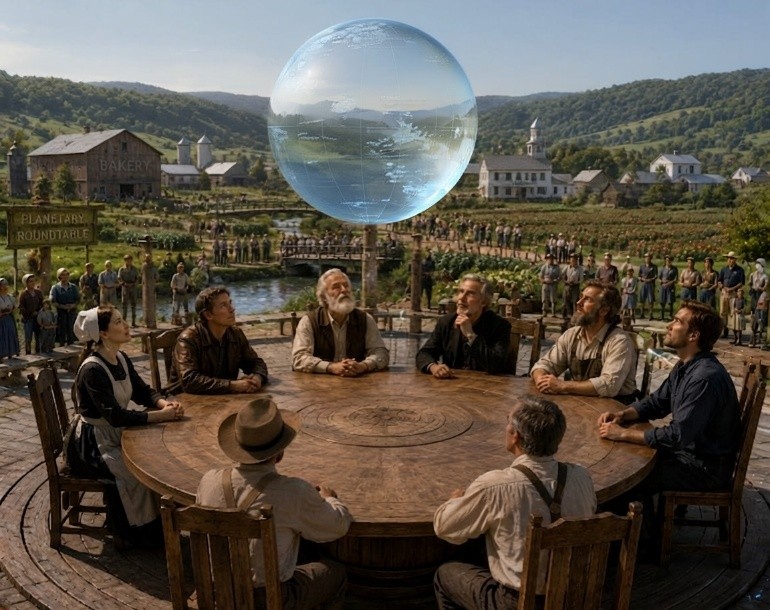
After breakfast, twelve people gathered beneath the open roof of the Planetary Roundtable.
No guards stood at the entrance.
No banners claimed authority over anyone seated there.
The Roundtable passed no laws, collected no taxes, and commanded no army.
It existed for one purpose.
It was the place where Earth settled its business with the universe.
Samuel and Rebecca sat together.
Beside them were Buck Rogers, Galileo Maestro, Elias Hawking, and Jacob Yoder.
Across the table sat Gaddy in the protective clothing worn upon arrival from the Anunnaki craft.
Zeta sat nearby with Orin, Sela, Nek, and Tavi.
No chair stood at the head because the table had no head.
Above them, the crystal orb hovered in silence.
Galileo touched the control embedded beneath the edge of the table.
Light stirred inside the orb.
The settlement appeared across the tabletop.
Fields unfolded in miniature.
The kitchen, dairy, creamery, mill, sawmill, glassworks, cannery, pantry, cabins, carnival, and orchards rose from the illuminated landscape. Tiny wagons moved along the roads. Horses crossed the fields. Smoke drifted from chimneys no larger than matchsticks.
Beyond the open side of the Roundtable, Saturn hung in magnificent indifference.
The planet offered no opinion.
Saturn cared nothing for gold, invoices, cargo, or trade.
Its rings simply stretched across the sky while the people below prepared to conduct the first auction between Earth and another world.
Buck stood.
“The Greys have withdrawn from the auction.”
Gaddy turned toward Zeta.
“Why?”
Zeta answered without hesitation.
“We intend to remain on Earth and learn everything the Amish are willing to teach.”
Gaddy’s expression changed only slightly.
“You would abandon the opportunity to purchase food?”
“We would exchange the opportunity to consume food for the ability to produce it.”
The orb shifted, displaying the greenhouse and the teams plowing the cabbage fields.
Zeta continued.
“We do not yet know whether our planet has tillable soil. We do not know the depth of our topsoil, the chemistry of our ground, the length of our natural seasons, or whether our controlled climate has prevented the cycles necessary for cultivation.”
Samuel folded his hands on the table.
“Those are the right questions.”
“We intend to learn how to answer them.”
Gaddy looked from Zeta to the four other Greys.
“And pizza?”
Zeta remained perfectly serious.
“Pizza remains part of the research.”
Rebecca covered a smile with one hand.
Buck cleared his throat.
“That leaves us with one bidder.”
The orb changed again.
The valley disappeared.
In its place appeared the interior of the new pantry.
Row after row of shelves extended across the table. Wooden crates, barrels, crocks, sacks, boxes, and pallets glowed beneath the orb’s light.
Buck lifted the wooden auction mallet.
“Everything offered for sale has been divided into numbered lots. The inventory includes canned tomatoes, corn, green beans, peas, carrots, beets, sauerkraut, fruit, canned meat, flour, cornmeal, oats, cheese, butter, honey, bottled spring water, glass jars, windows, candles, soap, tobacco, leather goods, furniture, and other finished products marked for export.”
The display moved from one section to another as Buck spoke.
“No horses are included.”
Gaddy looked toward Samuel.
“Why not?”
“They are family,” Samuel answered.
“No elephants either,” Buck added.
Gaddy looked toward Mike, who stood just beyond the open wall listening.
“What if I made a separate offer?”
Mike shook his head.
“They’re not for sale.”
“Everything has a price.”
“Not everything,” Mike replied.
Buck returned his attention to the auction.
“The opening bid for all goods marked for sale is three thousand gold coins. Each coin must contain one-quarter troy ounce of gold and bear the stamped value of five.”
Gaddy leaned back.
No competing bidder waited to raise the price.
No merchant whispered advice.
The Greys had chosen knowledge.
The humans were selling only what they had already decided to spare.
Buck raised the mallet.
“Do I hear the opening bid or a higher offer?”
Gaddy brought a closed fist down upon the table.
“Sold.”
The sound echoed beneath the roof.
Buck looked at the mallet still held in his own hand.
“You’re supposed to let the auctioneer do that.”
Gaddy withdrew the fist.
“You were taking too long.”
A ripple of laughter moved around the table.
Buck struck the table once with the mallet.
“Sold to Gaddy for three thousand quarter-ounce gold coins.”
Gaddy looked into the illuminated pantry.
“Now tell me exactly what I have bought.”
“You bought everything,” Buck said.
“Everything displayed?”
“Everything bearing an auction number.”
Gaddy studied the rows of goods.
“How much space does it occupy?”
Buck touched the table.
Figures appeared beside the glowing inventory.
“The auction goods occupy approximately sixty-eight hundred square feet of pantry floor. Most of the crates are stacked. Packed for transport, the shipment represents about forty-four thousand cubic feet.”
Gaddy’s eyes followed the figures.
“With bracing, walkways, and safe separation,” Buck continued, “you should allow fifty thousand cubic feet.”
“One ship may be sufficient.”
Buck did not look convinced.
“May be?”
“Our cargo bay is large.”
“How large?”
Gaddy hesitated.
The question had apparently never mattered when the purchase was merely called everything.
Buck continued.
“A deck one hundred feet long, sixty feet wide, and nine feet high would hold the volume. But volume isn’t your only concern.”
“Weight?”
“Exactly.”
Another set of figures appeared.
“Canned goods, bottled water, flour, glass, and cheese are heavy. We estimate the total shipment between six hundred fifty and eight hundred tons.”
Gaddy looked toward Elias.
“Your gravity permits that much weight to be moved?”
Elias smiled.
“Earth has been moving it since before anyone here was born.”
“That is not what I asked.”
“No,” Elias said, “but it remains true.”
Buck leaned forward.
“How much cargo weight can your ship safely carry?”
“I will have the specifications transmitted.”
“So one ship may not be enough.”
“No.”
“When can you bring more ships?”
Gaddy’s attention returned to Buck.
“Four days.”
“How many?”
“As many as necessary.”
Buck nodded.
“Then we begin staging the cargo tomorrow.”
Gaddy appeared satisfied.
Buck was not finished.
“Do you have the gold with you, or must you send for it?”
The room became quiet.
Outside, the faint ring of Jacob’s brick hammer traveled up the hill from the valley.
Gaddy placed both hands on the table.
“I have gold aboard my ship.”
“All of it?”
“A sufficient deposit to begin loading.”
Buck sat back.
“How much is sufficient?”
Gaddy considered the answer.
“Half.”
Samuel looked toward Buck but said nothing.
Gaddy continued.
“Fifteen hundred coins now. The remaining fifteen hundred when the additional ships arrive.”
The offer sounded reasonable.
It was meant to.
Inside Gaddy’s thoughts, however, another plan had already begun assembling itself.
Half the price would be painful to lose.
But half the price was better than losing everything.
If the humans could be persuaded to begin loading immediately, the first ship could depart before the remaining payment arrived. Additional vessels might accept cargo in the confusion. A large enough movement of crates, wagons, loaders, and ships could produce errors.
Errors could become opportunity.
Gaddy looked toward Zeta.
Zeta’s large dark eyes rested upon Gaddy.
For one uncomfortable instant, Gaddy remembered that Zeta did not need spoken words to hear a plan.
Zeta said nothing.
Buck folded his arms.
“We can accept a deposit.”
Gaddy relaxed.
“But we will not load against the entire purchase.”
The relaxation disappeared.
Buck pointed toward the orb.
“We are not loading a pantry. We are loading numbered lots.”
The inventory separated into blocks of light.
Each block received a number.
“Every lot has a count, weight, value, and loading record. Your deposit purchases specific lots equal to the amount paid.”
Gaddy frowned.
“I purchased everything.”
“You did,” Buck replied. “And when everything is paid for, everything will be yours.”
“You doubt my credit?”
“We don’t know whether you have any credit.”
The plainness of Buck’s answer left nowhere for offense to hide.
Samuel spoke gently.
“This community does not live on debt. We do not ask anyone else to live on ours.”
Buck continued.
“Fifteen hundred coins will release fifteen hundred coins’ worth of goods. Those lots will be counted, weighed, pulled from storage, and loaded. When the remaining gold arrives, the remaining lots will be released.”
Gaddy looked around the table.
“You do not trust me.”
Rebecca answered.
“Trust doesn’t require us to become careless.”
Gaddy turned toward Rebecca.
Rebecca’s expression remained warm.
“We fed you before asking what you could pay. We gave you a place to sleep without requesting a deposit. That is hospitality.”
Rebecca glanced toward the glowing inventory.
“This is business.”
Samuel nodded.
“We extend hospitality freely. We do not extend debt.”
Gaddy looked back at the orb.
The numbered lots glowed in separate groups.
No crate could disappear into a crowd of other crates.
No wagon could be loaded without a corresponding payment.
No ship could receive more than had been released.
Buck touched another control.
Three columns appeared above the table.
SOLD
PAID
LOADED
“At any moment,” Buck said, “both sides will know exactly where the transaction stands.”
Gaddy studied the words.
“When a lot is sold, it appears in the first column. When payment is received, it moves into the second. When the final crate crosses the loading ramp, it moves into the third.”
“And if one crate is missing?”
“The lot remains incomplete.”
“If one crate is damaged?”
“It does not leave the loading area until both sides agree how to settle it.”
“If my ship cannot accept the full weight?”
“The goods remain on Earth until another ship arrives.”
Gaddy looked toward the three columns.
“You have thought of everything.”
Buck smiled.
“No. We’ve simply spent enough years hauling freight to know what can go wrong.”
Samuel looked toward Gaddy.
“Honest trade protects the buyer as much as the seller. When your ships leave, you will know that every crate you paid for is aboard.”
“And Earth will know every crate aboard has been paid for,” Gaddy replied.
“Exactly.”
For several moments, the only movement came from the miniature wagons crossing the valley beneath the orb.
Then Gaddy nodded.
“I will transfer fifteen hundred coins from my ship.”
Buck lifted the mallet again.
“Then we’ll begin with half the inventory.”
Gaddy looked sharply toward him.
“Not half the inventory.”
Buck waited.
“Half the value,” Gaddy corrected. “Choose the lots carefully.”
“Do you have a preference?”
“Food first.”
“What kind?”
Gaddy looked at the canned tomatoes glowing nearest the center of the display.
“My people tasted Earth through tomatoes.”
Samuel smiled faintly.
“Then tomatoes should travel first.”
“Tomatoes,” Gaddy agreed. “Canned meat. Cheese. Flour. Honey. Bottled water.”
“And pizza?” Zeta asked.
Gaddy looked toward Zeta.
“Pizza does not travel well.”
Rebecca leaned forward.
“The ingredients do.”
The orb displayed flour, cheese, canned tomatoes, herbs, and cured meat.
Zeta studied the arrangement.
“A complete nutritional platform.”
Buck sighed.
“It’s a pizza.”
“Both descriptions are correct,” Galileo said.
Rebecca laughed.
“Then we’ll include a recipe.”
Zeta turned toward Gaddy.
“The turtles may yet influence Anunnaki history.”
Gaddy looked around the table, uncertain whether anyone else understood.
No one explained.
Buck struck the table once.
“First payment: fifteen hundred quarter-ounce gold coins.”
The corresponding lots glowed green.
“Tomorrow morning, we begin pulling inventory.”
Jacob studied the display.
“How many wagons?”
“Every freight wagon we can spare,” Buck answered. “We’ll stage the goods beside the pantry, count each crate as it leaves the shelves, and count it again before it reaches the ship.”
Elias looked toward the glowing lots.
“We should also separate by weight. Water and canned goods on the lower deck. Glass and furniture where they can be braced.”
Buck nodded.
“Good.”
Galileo watched the miniature pantry beneath the orb.
“For centuries, people looked toward the stars and wondered what visitors from other worlds might bring to Earth.”
Samuel followed his gaze.
“Turns out the first question was what they might take home.”
Beyond the Roundtable, Saturn remained silent.
The old planet had watched storms larger than Earth, moons fracture, rings form, and civilizations rise beneath distant suns.
It offered no advice.
Below its rings, however, twelve people sat around a table and worked out how to load tomatoes onto a spaceship without losing count.
The universe had finally come to trade.
Earth had brought a pantry.