Taking the Carnival Home

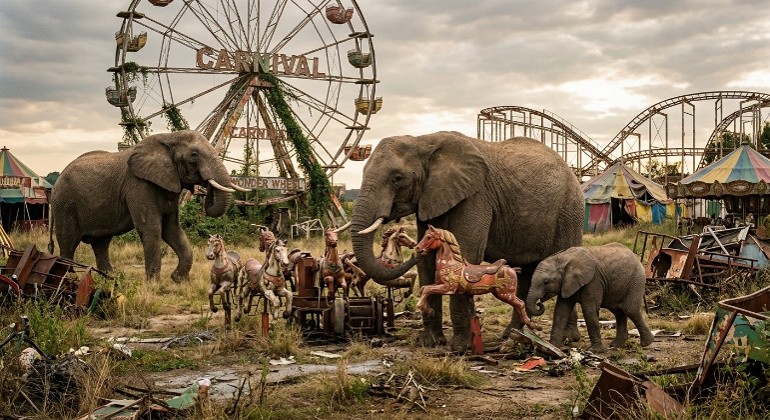
The Fokker stood at the edge of the field with its nose pointed toward the distant hills.
Its engine was silent, but the aircraft still looked impatient, as though it had landed only long enough for Buck Rogers and Mike the Gazoony to finish their conversation.
Mike leaned against the lower wing while Buck spread a rough map across it.
The abandoned carnival sat nearly forty miles downriver. The distance was manageable. Everything between the settlement and the carnival was another matter.
Neglected roads.
Overgrown intersections.
Bridges no one had inspected in years.
And five semi trucks Mike had kept alive through patience, scavenged parts, and a mechanic’s refusal to surrender useful machinery.
Buck tapped the map.
“How many men?”
“Twenty-five ought to do it.”
“Carnival men?”
Mike shook his head.
“There aren’t any carnival men left.”
“What kind, then?”
“Strong fellows. Mechanically minded. Men who aren’t afraid of heights.”
Buck looked toward the settlement.
“We have those.”
Mike folded the map and handed it back.
“I need men who listen. A carnival comes apart in a certain order. Take the wrong brace loose, and a ride can settle where you don’t want it.”
“On top of somebody?”
“That would be one of the places.”
Buck tucked the map beneath his arm.
“And the trucks?”
“Still waiting where I left them.”
“You’re certain they’ll run?”
Mike looked mildly offended.
“I’ve nursed those trucks for two years.”
“That wasn’t my question.”
“They’ll run.”
Buck smiled.
“That was my question.”
Mike pushed himself away from the wing.
“We’ll need wagons for tools, blocking timber, food, water, and anything the trucks can’t carry on the first trip.”
“And fuel.”
Mike’s expression changed.
“There should be enough in the tanks to get them home, provided we don’t spend half the day idling.”
Fuel had become too precious to waste. A truck moving an entire carnival ride was worth feeding. A truck left running merely for convenience was not.
Buck looked once more toward the hills.
“Let’s find Jacob.”
Jacob Yoder stood beside the brick kiln watching a fresh row of bricks being stacked beneath the curing shed.
His corncob pipe rested between his teeth. A thin ribbon of smoke drifted upward and vanished into the steady light of the Glove.
There had been no sunrise that morning.
There had not been a sunrise for years.
The light simply strengthened until the valley awakened.
Jacob saw Buck and Mike approaching and tapped the bowl of his pipe against the heel of his boot.
“You fellas look like you’ve found more work.”
Mike stopped in front of him.
“Jacob, we need some strong fellows who aren’t afraid of heights and have a basic understanding of mechanics.”
Jacob glanced toward the kiln.
“How many?”
“Twenty-five.”
“What are we building?”
“We’re not building anything.”
Mike smiled.
“We’re taking a carnival apart.”
Jacob returned the pipe to his mouth.
“That sounds suspiciously like work.”
Buck unfolded the map.
“We found it downriver. Ferris wheel, carousel, bumper cars, several other rides, generators, trucks, trailers, and whatever else has survived.”
Jacob studied the marks on the paper.
“You intend to bring all of it here?”
“Beside the Planetary Roundtable,” Buck said.
Jacob looked up.
“A carnival beside the Roundtable.”
Mike nodded.
“People traveling this far ought to have something to do besides stare at one another.”
Jacob considered that.
“Fair enough.”
He turned toward the brick crews and raised his voice.
“I need men who understand tools, machinery, rigging, or heights.”
Several heads lifted.
Jacob added, “Anybody who merely thinks he understands those things should remain where he is.”
Laughter moved through the workers.
Men began stepping out from the sheds and work areas. Carpenters, millwrights, wagon builders, mechanics, blacksmith apprentices, and several young men accustomed to climbing barn frames gathered in front of Jacob.
He counted them.
Twenty-seven.
Jacob pointed at two.
“You two stay with the kiln. These bricks will not stack themselves simply because a Ferris wheel has become lonely.”
The remaining twenty-five waited.
Mike looked them over.
Some were broad-shouldered. Others were lean and wiry. Most wore suspenders and straw hats.
None looked like a Gazoony.
That could be corrected.
“There are rules,” Mike said.
The men listened.
“Nothing comes apart until I tell you what supports it.”
He held up one finger.
“Every bolt, washer, spacer, pin, and bracket goes into a marked bag.”
A second finger.
“Every piece gets tagged before it leaves the ground.”
A third.
“If you don’t know where something belongs, ask.”
One of the younger men raised his hand.
“What’s a Gazoony?”
Mike looked at Buck.
Buck looked at Jacob.
Jacob puffed his pipe.
“I believe that was an important question.”
Mike grinned.
“A Gazoony is a carnival worker who knows how to do six jobs, claims he can do twelve, and somehow gets all eighteen finished before the gates open.”
The young man nodded.
“Then we should be ready.”
Mike stared at him for a moment.
Jacob tapped the ashes from his pipe.
“He may fit the description.”
The wagons left the settlement beneath the full working light of the Glove.
They carried men, tools, chains, pry bars, heavy oak timbers, food, water, canvas bags, tags, grease pencils, rope, and enough spare lumber to build blocking beneath anything Mike refused to trust to bare ground.
The road had not disappeared, although from a distance it often looked as though it had.
Grass grew through cracks in the asphalt. Bushes leaned over the shoulders. Small trees had taken root where drainage ditches once ran clear.
Beneath it all, the old highway remained.
The wagon wheels bumped over broken pavement and disappeared occasionally beneath long stretches of green.
Mike rode in the lead wagon beside Buck.
“You expected this?” Buck asked.
“The road?”
“The damage.”
Mike nodded toward the stack of oak planks behind them.
“I expected worse.”
They found worse at the creek.
The convoy stopped before a bridge where part of the pavement had collapsed, leaving a ragged opening above the water.
Buck climbed down first.
Nobody crossed.
The men walked the bridge, examined the remaining concrete, checked the abutments, and looked beneath the deck.
Mike crouched at the damaged section.
“The bridge is still carrying itself.”
Jacob studied the broken edge.
“Carrying itself and carrying loaded trucks are different matters.”
“That’s why we brought the timber.”
The men unloaded the precut oak planks.
They laid heavy supports across the damaged section, spreading the load onto sound portions of the bridge deck. More timbers followed, placed side by side until the opening disappeared beneath a temporary wooden roadway.
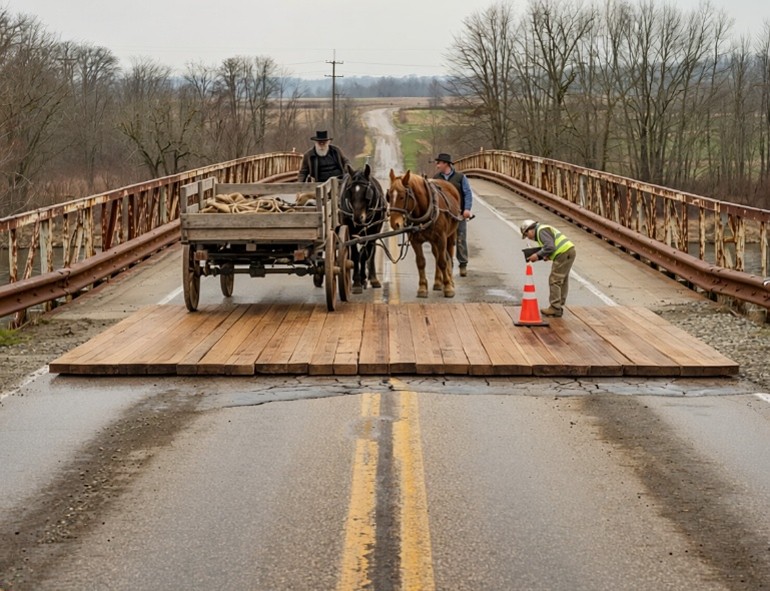
Nothing was hurried.
The first empty wagon crossed slowly.
Men watched the timbers.
Nothing shifted.
The second wagon followed with part of the tool load.
Still nothing moved.
Jacob walked back across the bridge, tapping one timber with the heel of his boot.
“That will carry the wagons.”
Mike looked toward the road beyond.
“And the trucks?”
Jacob studied the deck once more.
“One at a time. Slow. Nobody else on the bridge.”
Mike nodded.
“That’s all I need.”
The convoy continued.
The carnival appeared beyond a bend in the river road.
The Ferris wheel rose above the trees first.
Then came the carousel roof, faded canvas awnings, ride arms, ticket booths, trailers, and a crooked sign that no longer announced anything to anyone.
The midway was silent.
Weeds pushed through gravel.
Leaves collected beneath the rides.
A row of empty game booths stared across the grounds with their prizes long gone.
Twenty-five men climbed down from the wagons and stood looking at the abandoned machinery.
Mike walked ahead of them.
For several moments he said nothing.
Buck came to stand beside him.
“You all right?”
Mike looked across the midway.
“I spent most of my life listening to places like this.”
“To what?”
“Generators. Music. Children laughing. Ride operators shouting.”
He rubbed his hands together.
“This place has been quiet too long.”
Jacob approached with his pipe in one hand.
“Where do we start?”
Mike turned toward the men.
“We’re not tearing down a carnival.”
He pointed toward the Ferris wheel.
“We’re taking it home.”
Jacob placed the pipe between his teeth.
“Then let’s wake her up.”
The men moved.
Mike led them behind a line of equipment trailers where weeds had grown almost to the windows.
Buck stopped.
Parked beneath leaves and dust sat a crane truck and a modern man lift.
“You neglected to mention those.”
Mike opened the crane’s cab.
“I wanted to see whether they were still here before I started bragging.”
He checked the fluids, inspected the hoses, and climbed behind the wheel.
The engine turned slowly.
Once.
Twice.
Then the diesel coughed, released a dark puff of smoke, and settled into a rough but steady idle.
Several men applauded.
Mike leaned out the window.
“Save the cheering. She hasn’t lifted anything yet.”
The man lift required more persuasion, but its engine also awakened. Hydraulic cylinders trembled. The basket rose several feet, paused, and lowered again.
Mike shut both machines down until the crews were ready.
“No fuel wasted,” he said.
The first major task was the Ferris wheel.
Mike divided the men into crews.
One group removed the passenger gondolas.
Another prepared the flatbed trailers.
A third set heavy blocking timbers where the steel sections would be lowered.
Two men climbed into the man lift’s basket with tools, tags, canvas bags, and grease pencils.
Mike pointed toward the outer rim.
“You’ll take it apart one arm section at a time.”
He held up a bag marked:
FERRIS WHEEL
OUTER RIM
SECTION ONE
“Every fastener from that section goes in this bag. Not in your pocket. Not on the ground. Not in a bucket with parts from somewhere else.”
One of the men examined the writing.
“When we rebuild it, this bag returns to this section?”
“Exactly.”
“Where do you want the first section placed on the trailer?”
Mike pointed.
“Forward of the axles, but not against the headboard. Leave room for the center braces.”
The man nodded.
That was the first question.
It was also the right one.
The crane’s outriggers settled onto timber pads.
The boom rose.
A cable took the weight of the first Ferris wheel section while the man lift carried the workers upward.
The impact wrench rattled.
Bolts came free one by one.
Each went directly into the marked canvas bag.
When the last bolt was removed, the crane operator eased the steel section away from the wheel.
It hung briefly in the still air, then descended toward the waiting fifty-three-foot flatbed trailer.
Mike walked beside it, guiding the load.
“Six inches left.”
The section moved.
“Good. Lower.”
It settled onto the blocking precisely where he had instructed.
The men secured it.
Mike marked the trailer manifest.
“Section one.”
He looked up.
“Again.”
The carnival began coming apart in several places at once.
At the carousel, men removed the painted horses, tagging every pole and mounting bracket.
At the Tilt-A-Whirl, tubs were lifted from their platforms and placed onto cribbing.
The Scrambler crew disconnected its long arms, wrapped the bearings, and stacked each piece in order.
Electrical wires were labeled at both ends.
Hydraulic hoses were capped.
Gearboxes were drained where necessary and wrapped against dust.
Fasteners vanished into bags bearing the name of the ride, the location, and the section number.
Mike moved from crew to crew.
He expected confusion.
He found concentration.
A young man at the carousel held up a brass bushing.
“Mike, does this stay with the horse assembly or the center drive?”
“Center drive.”
The man placed it in the proper bag and returned to work.
Another called from beneath the Scrambler.
“Do you want the support arms loaded in the order they came off?”
“Yes.”
“Front to back or back to front?”
Mike smiled.
“Back to front. Then the first piece we need will be the last one loaded.”
The man nodded as though the answer had confirmed his own thinking.
Buck noticed Mike standing with his hands on his hips.
“Something wrong?”
Mike shook his head.
“Quite the opposite.”
He watched two men wrap a gearbox in oilcloth before lowering it onto a pallet.
“These fellows knew nothing about carnivals when we arrived.”
Buck looked across the midway.
“They seem to be learning.”
“They work like experienced Gazoonies.”
Mike continued watching.
“They don’t waste questions.”
“What do you mean?”
“Nobody asks when we’re quitting. Nobody asks whose job something is. Nobody asks whether close enough is good enough.”
Across the midway, a worker called out.
“Mike, where do you want the carousel poles?”
“Trailer three, left side, separated with timber.”
The worker waved and returned to the task.
Mike gestured after him.
“They only ask where and what.”
Jacob stood nearby, relighting his pipe.
“Where does it go, and what does it do?”
“Exactly.”
Jacob drew on the pipe until the tobacco caught.
“A man doesn’t need to know every machine.”
Mike looked at him.
“No.”
“He needs to know how to look at one.”
Mike smiled.
“Jacob, you may have been a Gazoony all your life.”
Jacob tapped the ashes from his pipe.
“I have made other mistakes.”
By midday, the impact wrenches began to slow.
Mike sounded the horn on the crane truck.
Tools fell silent across the carnival.
One of the younger men looked up from beneath the Tilt-A-Whirl.
“Trouble?”
“Lunch.”
The men gathered beneath the remaining shade of the Ferris wheel.
Rebecca had packed bread, smoked ham, cheese, hard-boiled eggs, pickles, apples, and enough tomatoes to remind everyone where they came from.
Stoneware jugs held cold spring water.
Men sat on blocking timbers, trailer decks, wagon tongues, and overturned toolboxes.
Jacob leaned against a tire and began constructing a sandwich tall enough to require engineering.
One young worker rubbed his shoulders.
“I didn’t know Ferris wheels weighed so much.”
Jacob examined his sandwich.
“That’s because you’ve never picked one up before.”
The men laughed.
Another worker held up the heavy impact wrench.
“This thing weighs more than my wife.”
Jacob took a bite.
“Then I advise against confusing them.”
The laughter grew louder.
Mike sat beside Buck with his back against a trailer wheel.
Buck handed him a tomato.
“Anything surprise you?”
Mike looked across the grounds.
“The men.”
“Good surprise?”
“The best kind.”
He bit into the tomato and wiped juice from his chin.
“I thought I’d spend the day teaching.”
“And?”
“I spent it answering sensible questions.”
Jacob spoke from nearby.
“That can be exhausting.”
Mike pointed the tomato at him.
“You’re enjoying this.”
“I generally enjoy watching other people work.”
“You’ve been working all morning.”
Jacob nodded.
“That explains why I’m tired of it.”
The teasing continued while the men ate.
For a little while, the carnival grounds sounded less abandoned.
Then a trumpet rolled across the midway.
Every man stopped in motion.
A sandwich remained halfway to someone’s mouth.
Jacob’s pipe hung below his lower lip.
The sound came again, deeper this time.
Branches moved beyond the carousel.
A massive bull elephant stepped into view.
Jumbo entered the midway with his trunk swinging and his ears gently fanning. Beside him walked Daisy, watchful and calm.
Between them hurried a smaller elephant, her ears flapping as she tried to match the stride of her parents.
Mike stood.
“Well, look who finally reported for work.”
Jumbo raised his trunk and trumpeted again.
The sound traveled across the river and returned from the distant hills.
Nobody spoke until Jacob removed his pipe.
“You neglected to mention the elephants.”
Mike grinned.
“I neglected to mention several things.”
The little elephant wandered toward the men, sniffing the air.
“Her name is Rosie,” Mike said.
Rosie discovered the basket containing the remaining tomatoes.
Daisy touched the calf gently with her trunk and guided her away.
Jacob watched them.
“Good parenting.”
Mike walked toward Jumbo.
The bull lowered his head.
With practiced ease, Mike stepped onto the elephant’s bent front leg, climbed upward, and settled behind Jumbo’s ears. His legs hung around the great animal’s neck as though he had taken the same seat every morning of his life.
Jumbo began walking through the midway.
Daisy followed.
Rosie hurried behind them, occasionally breaking into an awkward little trot.
The Amish men laughed and cheered at the same time.
Several waved their hats.
Mike raised one hand like a parade marshal passing before a grandstand.
Buck’s eyes rolled back in his head.
“I wonder if I should believe what I’m seeing.”
Jacob tapped the ashes from his pipe.
“I expect the elephant believes it.”
Jumbo carried Mike around the carousel and back toward the Ferris wheel.
Rosie strayed toward the workers.
She inspected a toolbox, sniffed a coil of rope, and attempted to remove a straw hat from one man’s head.
Mike looked down from Jumbo.
“She thinks she’s helping.”
Jacob accepted his hat back from Rosie.
“Nobody can explain to her she isn’t Amish.”
Buck watched Rosie fall into step beside several of the workers.
“I’m not sure anybody should try.”
The break ended when Mike climbed down from Jumbo.
He rubbed the elephant’s trunk.
“We’ll be back for you.”
Jumbo answered with a low rumble.
Daisy and Rosie followed him toward the river, where the family had been grazing.
The men returned to their crews with fresh energy.
Impact wrenches rattled again.
The crane lifted.
The man lift rose.
By late afternoon, the Ferris wheel had lost most of its outer rim. The carousel horses stood in padded rows inside a trailer. The Scrambler’s arms rested on blocking, strapped according to size and order.
Nothing had been thrown into a pile.
Nothing had been left unidentified.
Every trailer became a three-dimensional map of how the carnival would someday rise again beside the Planetary Roundtable.
Mike stood in the midway and looked around.
The work was moving faster than he had believed possible.
Buck joined him.
“How long?”
“At this rate?”
Mike studied the remaining rides.
“A few days to bring down the major pieces. Longer to load everything correctly.”
“We can send the first trucks home before the last ride is packed.”
Mike nodded.
“That’s the way to do it. The settlement crew can begin unloading and organizing while we finish here.”
He pointed toward the Ferris wheel trailer.
“That one goes first.”
“Why?”
“Because it will take the longest to rebuild.”
Buck looked at the giant wheel, now open to the sky where several rim sections had been removed.
“You’ve already planned where it stands?”
“Above the Roundtable, on the flattened hilltop beside the artesian well, but far enough away that nobody negotiating the future of Earth has to shout over carnival music.”
Buck smiled.
“Thoughtful.”
“I’ve attended meetings.”
Another Ferris wheel section descended.
The men guided it onto the trailer and secured it.
Mike checked the placement.
Perfect.
He looked across the carnival at the crews who had arrived knowing nothing about rides and now moved among them with the discipline of men who had done this work for years.
Not carnival men.
Not yet.
But Gazoonies all the same.
Mike marked another line on his clipboard.
“Section seven loaded.”
Jacob raised his pipe toward the remaining wheel.
“How many more?”
“Enough to keep you from watching other people work.”
Jacob studied the Ferris wheel.
“Then we had better continue.”
The men laughed and returned to their positions.
Above them, the old carnival slowly disappeared from the skyline.
They were not dismantling joy.
They were packing it carefully for the journey home.