The Good Earth • Saga #1 of the Planetary Roundtable
Chapter Nine
The Wagon Train
After supper, the working men drifted toward the brick pile.
It had become their place without anyone naming it so. Rebecca's kitchen fed the settlement, but the brick pile helped the men settle their minds after the work was done.
Jacob Yoder sat on one corner with his corncob pipe glowing.
Frank Cooper leaned against a stack of cured bricks, rubbing sawdust from his hands.
John Miller rested with his back against a wagon wheel.
Elias sat cross-legged on the bricks with a notebook in his lap.
Buck Rogers stood nearby with his clipboard tucked beneath one arm.
For a while, nobody spoke.
A good supper and honest labor made silence comfortable.
Finally Jacob puffed his pipe and looked toward Buck.
"How many wagons do you figure it'll take to move that glass factory?"
Buck smiled.
"I was hoping somebody would ask."
The men chuckled.
Buck opened his clipboard.
"Twenty wagons to begin with."
Frank whistled softly.
"That's not a trip. That's a parade."
"No," Buck said. "A parade goes nowhere useful. This is a wagon train."
John Miller nodded.
"How do you want it arranged?"
Buck turned a page.
"Jake rides near the front because he knows what we're touching. Elias rides beside him because every machine gets numbered, sketched, and marked before a bolt is removed."
Elias nodded.
"Nothing comes apart until we know how it goes back together."
"The blacksmiths ride behind them," Buck continued. "Chains, hooks, wedges, tools, and axle repair. If something breaks, I don't want the repair crew three wagons behind the problem."
Jacob puffed thoughtfully.
"Makes sense."
"Carpenters next," Buck said. "Frank's men will build crates, skids, braces, and glass racks on site. John, your loggers bring rollers, blocking, and heavy lifting timbers."
John nodded.
"We'll bring men who know how to move weight without arguing with it."
"Good," Buck said. "The rear wagons stay empty going out."
"Why empty?" one man asked.
Buck smiled.
"Because an empty wagon is a promise."
The men grew quiet.
"It leaves with nothing," Buck said, "and comes home carrying part of the future."
Jacob grunted approvingly.
"That's a fine use for empty."
Buck looked around the circle.
"Nobody races. Nobody passes. If one wagon stops, we all stop. If one horse needs water, every horse gets water. If one load shifts, every driver checks his load."
Frank studied him.
"You're planning this like we're crossing the continent."
Buck shook his head.
"Worse. We're carrying glass."
Laughter rolled around the brick pile.
Buck waited for it to fade.
"I mean it. A broken jar teaches us nothing. A broken machine may cost us weeks. A broken axle may cost us horses. Slow is smooth. Smooth is fast."
Jake, who had been quiet until then, looked at Buck with growing respect.
"You've moved things before."
Buck closed his clipboard.
"I've cleaned up after people who moved things badly."
That brought another round of laughter.
Samuel stood at the edge of the group, listening more than speaking. When the laughter faded, he stepped forward.
"Men, this will be the largest task we've attempted together. We are not going to the factory to strip it like thieves. We are going to bring home what can serve everyone."
Jake lowered his eyes.
For years he had watched over those silent buildings alone.
Now the factory was no longer a ruin to be guarded.
It was a craft to be continued.
Samuel turned toward him.
"Jake, tomorrow you are not simply showing us machinery. You are teaching us how to respect your trade."
Jake removed his cap.
"I'll do my best."
Samuel smiled.
"That's all we ask of any man."
Across the yard, Rebecca stepped onto the kitchen porch.
"If you men are finished planning tomorrow, there is coffee inside."
Jacob tapped his pipe against a brick.
"Rebecca, if you keep feeding us this well, Buck will need twenty more wagons just to haul us."
Rebecca laughed.
"Then I'll pack lighter lunches."
"No need for foolishness," Jacob said.
The men rose slowly, still smiling, and followed the smell of coffee toward the kitchen.
Buck remained by the brick pile a moment longer, looking over his notes.
Elias stepped beside him.
"You're worried about the sheet glass."
"I'm worried about everything."
"That's why Samuel picked you."
Buck looked toward the dark shapes of the wagons waiting near the barn.
"Tomorrow those wagons leave empty."
Elias nodded.
"And come home full."
Buck closed his clipboard.
"That's the plan."
Before breakfast had ended the next morning, the wagon train was already forming.
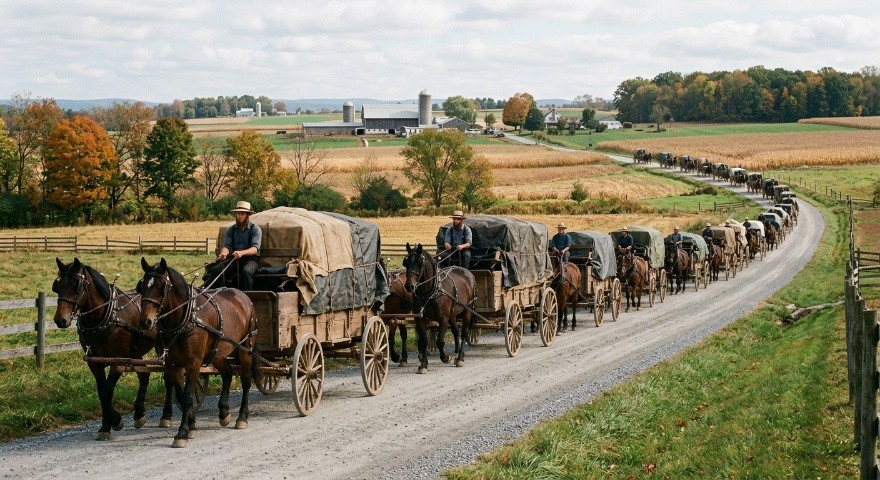
Twenty wagons stood in a long line along the road.
Each team had been watered, fed, and checked. Wheelwrights inspected spokes, hubs, and rims. Blacksmiths tested chains and hooks. Carpenters loaded timber, rope, canvas, straw, and tools. The loggers brought heavy poles for rolling machinery and thick blocks for lifting weight one careful inch at a time.
Rebecca and the women moved down the line handing food sacks to each driver.
"Don't eat it all before noon," she warned.
One driver grinned.
"No promises."
She pointed at him.
"I know your wife."
The man straightened.
"Then I promise."
Children gathered near the fence, whispering with excitement.
To them the wagon train looked grander than any parade the old world had ever known.
Jake stood beside the lead wagon, staring down the long line of horses, men, tools, and empty beds.
Buck climbed up beside him.
"You ready?"
Jake swallowed hard.
"I spent years wondering if I would ever hear that factory run again."
Elias climbed in behind them with notebooks, charcoal, tags, chalk, and twine.
"Today we start teaching it the way home."
Buck lifted the reins.
At the front of the line, Samuel raised one hand.
Every driver straightened.
Rebecca stood beside him with flour on her apron and pride in her eyes.
Samuel spoke just loud enough for the nearest men to hear, and the words passed quietly down the line.
"Bring yourselves home safe. Everything else can wait."
Buck nodded.
The lead team stepped forward.
One by one, the wagons began to roll.
Iron-rimmed wheels crunched along the road. Harness leather creaked. Horses snorted in the cool air. Men settled into their seats and checked their loads by habit.
The settlement watched as the wagon train moved away.
Not a parade.
Not a flight.
Not a search for rescue.
A community had decided what it needed and sent its own hands to retrieve it.
Galileo stood beside Samuel as the last wagon passed beyond the fields.
"Look at them," Galileo said.
Samuel nodded.
"What do you see?"
Galileo smiled faintly.
"People who no longer think only about surviving."
Samuel watched the wagons disappear along the road.
"What are they thinking about?"
Galileo listened to the steady fading rhythm of wheels.
"Tomorrow."
At the Kentucky Glass Container Factory, Jake climbed down before the horses had fully stopped.
He stood before the main doors and removed his cap.
For a moment Buck said nothing.
Neither did Elias.
Some places deserved silence before work began.
Jake unlocked the doors and pushed them open.
Dust floated in the filtered light.
The factory waited.
Men entered slowly, their boots echoing against the floor.
Furnaces lined the walls.
Long rows of forming machines sat silent.
Molds, conveyors, bins, racks, and worktables remained where Jake's people had left them.
Jake walked to the nearest machine and placed his hand upon it.
"Gentlemen," he said.
The workers gathered around him.
"Before anyone touches a wrench, understand this. Every bolt has a reason. Every gear has a place. Every shaft has a direction. If we respect the men who built this factory, it will serve us for another hundred years."
No one moved.
Jake pointed toward the warehouse.
"Finished jars come first. Sheet glass second. Machinery last. We load what helps the settlement immediately before we touch what helps us later."
Buck smiled.
"That was my plan."
Jake glanced at him.
"Then you had a good one."
Elias opened his notebook.
"I'll number each machine and sketch every assembly before it moves."
Frank's carpenters began measuring crates.
John Miller's men carried blocking and rollers inside.
The blacksmiths unrolled chains, hooks, wedges, and tools.
Buck stood near the main doors, watching the factory fill with motion.
No money changed hands.
No contracts were signed.
No one asked what they would be paid.
Each man simply took up the work that matched his hands.
By noon, the first wagons were loaded with crates of glass jars packed tight in straw.
The sheet glass came next, standing upright in wooden racks Frank's men built beside the warehouse doors.
Jake inspected every rack himself.
"Glass likes to stand," he told one young carpenter. "Lay it wrong and it punishes you."
The young man nodded carefully.
"I'll remember."
"Good," Jake said. "Glass remembers too."
The return trip moved slower than the journey out.
Buck rode ahead only far enough to see the road clearly, then slowed the team until every wagon held the same steady pace.
At the first rough stretch he raised his hand.
The entire wagon train stopped.
Drivers climbed down.
Loads were checked.
Ropes tightened.
Wheels inspected.
Horses watered.
Then they moved again.
No one complained.
Buck's rules had already become the road's wisdom.
As the settlement came into view, children began running toward the fence.
Rebecca stepped from the kitchen porch.
Samuel walked out to meet the lead wagon.
The first load rolled past him.
Crates of jars.
The second wagon.
More jars.
Then came the sheet glass, upright in padded wooden racks, catching the soft light as it moved.
Children pointed.
"What is it?"
Jake sat taller on the wagon seat.
"Those," he said, "are tomorrow's windows."
A murmur of wonder passed through the crowd.
Frank Cooper stood beside one of the unfinished houses, looking at the open window frames he had covered with shutters.
He removed his hat and smiled.
For the first time, he could see the rooms as they would be.
Warm.
Bright.
Finished.
The wagon train rolled into the settlement, empty no longer.
It had gone out carrying tools, lunches, and hope.
It returned carrying jars, windows, machinery, and the knowledge of a man who had waited years to teach again.
Samuel looked down the line of wagons and quietly gave thanks.
The glass factory had not yet been rebuilt.
Its furnaces had not yet been lit.
But something just as important had happened.
The factory had begun coming home.
The Good Earth • Saga #1 of the Planetary Roundtable