The Good Earth • Saga #1 of the Planetary Roundtable
Chapter Eleven
Passing It On
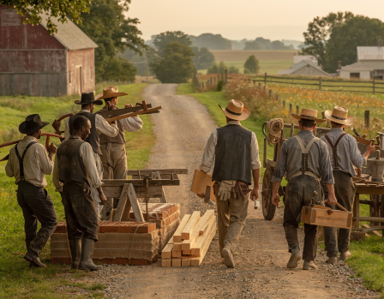
Breakfast had hardly ended before the settlement began moving in all directions at once.
Nobody waited for Samuel to stand on a brick pile.
Nobody waited for Buck Rogers to call out names.
The carpenters gathered near Frank Cooper.
The glass apprentices drifted toward Jake's temporary glass shop.
The brickmakers walked toward Jacob Yoder's clay pit.
The milkmaids crossed to the dairy barn.
Children carried pails, baskets, rags, and little tools, proud to be trusted with anything useful.
Samuel stood outside Rebecca's kitchen and watched them go.
Buck stepped beside him with his clipboard tucked under his arm.
"You notice it?"
Samuel smiled.
"I do."
Buck looked across the valley.
"Nobody's asking where to stand anymore."
"No," Samuel said. "They're asking where they can help."
At the carpentry shed, Frank Cooper stood beside a row of teenage boys while a freshly planed board rested across two sawhorses.
One boy ran his hand over the surface.
"Feels smooth."
Frank nodded.
"Smooth enough?"
The boy hesitated.
"I think so."
Frank handed him the plane.
"Then think again."
The boy took two more careful passes. Thin curls of wood rolled away and fell to the floor.
Frank tested the board with his palm.
"There."
The boy smiled.
"Now it's smooth."
Frank pointed toward the cabins.
"What do you see?"
"Houses."
Frank shook his head.
"Tables. Chairs. Beds. Shelves. Cradles."
The boy looked at the board.
"It's just lumber."
"No," Frank said. "It's somebody's supper table if you treat it right."
The boy looked at the board differently after that.
At Jake's glass shop, a young apprentice held his breath while scoring a pane of sheet glass.
Jake stood behind him.
"Don't force it."
The boy frowned.
"I'm barely touching it."
"Good. Glass doesn't like being bullied."
The boy drew the cutter along the line.
A fine whisper crossed the pane.
Jake nodded.
"Now break it clean."
The boy pressed carefully.
The glass separated with a crisp snap.
He looked up, amazed.
"I did it."
Jake held the pane toward the filtered light.
"You gave somebody a window."
"It's just glass."
Jake smiled.
"Not to the mother who watches her children through it."
At the brickworks, Jacob Yoder watched a young man pack clay into a mold.
The first brick came out crooked.
The young man sighed.
Jacob picked it up, turned it in his hands, and set it aside.
"Make another."
The second was better.
Jacob studied it.
"Make another."
By the fifth, the corners were sharp and the sides straight.
Jacob nodded.
"That one knows what it wants to be."
The young man laughed.
"A brick knows?"
Jacob puffed his pipe.
"Everything does, if you listen."
At the dairy barn, Rebecca stood with several young women while fresh milk was strained into clean cans.
One girl worked too quickly and splashed milk across the table.
Her face reddened.
"I'm sorry."
Rebecca handed her a cloth.
"Milk teaches patience."
The girl wiped the table.
"I thought I was helping."
"You are," Rebecca said. "Helping doesn't mean hurrying."
She lifted the can and showed the girl how to pour slowly, steadily, without wasting a drop.
"There now. Try again."
The girl did.
This time not a drop was lost.
Rebecca smiled.
"See? The cow did her part. Now we do ours."
At the flour mill, Galileo Maestro poured wheat into the hopper while two children watched the stones turn.
One boy asked, "Why do you work here?"
Galileo looked down at him.
"Because the mill needs a miller."
"But you moved the Earth."
Galileo brushed flour from his sleeve.
"The Earth only needed moving once."
He tied off a sack of fresh flour.
"People need bread every day."
The children considered that.
The younger one finally asked, "Is bread more important than moving the Earth?"
Galileo smiled.
"Ask Rebecca."
Samuel spent the day walking from one place to another.
He watched teenage boys learning to shape wood.
He watched young hands learning to cut glass.
He watched milk saved instead of spilled.
He watched bricks improve one mold at a time.
Everywhere he went, someone was teaching.
Everywhere he went, someone was learning.
Near the cabins, a young father carried a table toward his new home.
Behind him walked his teenage son.
"Careful with that end," the father said.
"I know," the boy answered. "I built it."
The father stopped and looked back.
"You built this?"
The boy stood straighter.
"Frank helped."
The father ran his hand over the table.
Then he nodded.
"Your mother will set supper on this tonight."
The boy said nothing, but his face changed.
He had carried lumber in the morning.
By afternoon, he had carried dignity.
After supper, the men gathered at the brick pile.
Pipes were lit.
Coffee was passed.
Frank lowered himself onto a stack of cured bricks with a satisfied groan.
"Those boys are learning faster than I expected."
Jake sat nearby with a small cut on one finger wrapped in cloth.
"Glass teaches quick. It doesn't repeat itself kindly."
Jacob puffed thoughtfully.
"Clay repeats itself all day long."
Buck grinned.
"And you still don't talk much."
Jacob looked at him.
"I talk to bricks."
The men laughed.
Samuel listened quietly.
Galileo sat beside him, flour still dusting his cuff.
Samuel looked across the settlement.
"We've been building houses, barns, mills, shops..."
Galileo shook his head gently.
"No."
Samuel turned to him.
"No?"
Galileo pointed toward a group of teenage boys carrying tools back to Frank's shed.
"You've been building craftsmen."
Samuel watched the boys disappear into the dimming work yard.
Then he looked toward Rebecca's kitchen, where young women were washing jars and laughing as they worked.
"Craftsmen and craftswomen," he said.
Galileo smiled.
"Yes."
Samuel leaned forward, elbows on his knees.
"Value is found in promoting life rather than destroying it."
The men grew quiet.
Samuel continued softly.
"If a thing feeds, shelters, teaches, heals, or gives hope, then it has worth. If all it can do is destroy, its value dies with the destruction."
Jake looked toward the cabins where light shone behind new windows.
"Glass can cut a man."
"Yes," Samuel said.
Jake smiled.
"But tonight it keeps children warm."
Frank nodded toward the chairs on several porches.
"Wood can build a coffin."
Samuel followed his gaze.
"And it can build a cradle."
Jacob lifted a brick.
"A brick can make a wall."
Buck added, "Or a chimney."
Rebecca had walked quietly over from the kitchen and stood listening.
"Or an oven," she said.
Everyone turned.
She smiled.
"And I favor ovens."
The men laughed, and the heaviness passed.
Later, Samuel and Galileo walked beyond the cabins.
The settlement glowed behind them, soft with lantern light and voices. The Glove's filtered sky shimmered overhead, and beyond it the rings of Saturn changed color in broad bands, like a peacock slowly opening its tail.
Samuel stopped and looked up.
"It's not a round and perfect world anymore."
Galileo followed his gaze.
"No."
Samuel smiled.
"But where else can a man stand after supper and watch Saturn dress itself in colors?"
Galileo laughed softly.
"I've begun to think the Amish may have made the most comfortable spacecraft in the universe."
Samuel looked amused.
"We didn't build a spacecraft."
"No," Galileo said. "That's why it works."
They stood together while the distant settlement breathed behind them.
A rocking chair creaked on a porch.
A child laughed.
Someone practiced a fiddle badly enough to prove he was learning.
Galileo looked back toward the cabins.
"Metal ships cross space. This one carries home through it."
Samuel folded his hands behind his back.
"And home is worth building."
Galileo nodded.
"Every day."
Behind them, the apprentices of the settlement slept under roofs built by their fathers, beside tables built by their sons, behind windows cut by careful young hands.
The work would begin again after breakfast.
Not because anyone feared hunger.
Not because anyone chased wages.
But because every willing hand had discovered something better than money.
Purpose.
The Good Earth • Saga #1 of the Planetary Roundtable